Eight-and-One-Half Signs that Spring Might Come. Someday. Maybe.

There is a is short distance between stubborn and foolish, and this morning both seem a lot closer than my office.

It is early March, and I am walking to work. A few months ago I would have prepared for this quarter-mile trek by layering my winter gear–fleece, scarf, coat, hat, gloves–but today I am convinced, thermometer-be-ignored, that spring has come. I zip up my fleece and head out the door.

Halfway down the hill my ears start to sting, and by the bottom they are mostly numb. Now I notice that the grass is white and furry, and the sidewalk shimmers with ice crystals. I shift my travel mug into the other hand as my fingers vie for their turn in my pocket.

Why didn’t I grab those gloves? They were right there; in the basket by the door.

As I trudge along, I get my answer. One after another, fellow foolish Pittsburgers pass me on the sidewalk. Very few pulled their gloves out of the basket this morning. “Stubborn under-dressed Pittsburghers,” I mutter in my head, “always a sure sign of spring.” And because I need distraction, I start a list as I shiver along the way.

* * * * *

Eight-and-One-Half Signs that Spring Might Come. Someday. Maybe.

One: Stubborn under-dressed Pittsburghers. Yesterday a friend told me that on the first fifty-degree day she sends all her winter coats to the cleaners, and replaces long-sleeved shirts with t-shirts in her dresser. Nevermind that our last frost date is May 1st. Nevermind that we will certainly get more snow before winter lets us go. Nevermind all this–we have waited long enough. Pull out the swimsuits!

Two: Mud. The coming of spring is the coming of mud, and by mud I don’t mean thin, sissy mud that splashes up from puddles and leaves a thin film on your car. I mean mud with heft, mud like a sumo wrestler who grabs at your heels. With. Every. Step. Every year I forget this mud, and every year I am reminded when the first child stomps into the kitchen, thick clumps in her wake. Which brings me to…

Three: Mud boots. In my house, there is a grand exchange sometime in mid-March of snow boots for mud boots, the fruit of my thrift store labor. You see, some people call mud boots ‘rain boots’ and once or twice they pull them out so their little children can splash in puddles. Adorable. Then the little children outgrow their cute boots, and their parents stuff them into a box for the thrift store.

And at t3206364327_52f534650a_z (1)his point they come to my house to be destroyed. Our little boot-butchers go through two pair of mud boots every spring, and two pair every fall. By the time we throw out each sacrifice they are cracked, duct-taped, ripped and leaking. Additionally, they stink, because it’s oh-so-easy to slip on mud boots without socks, no matter how many times your parents scold, “Go upstairs and get some… blah, blah, blah.”

Four: Full playgrounds and lines for ice cream. My children may tune out at “socks”, but “ice cream” comes through loud and clear. So, on the first sunny afternoon, we join the hordes at the playground, and then ‘cool off’ with a sweet frozen treat. We’re not sweating–yet–but ice cream reminds us that someday we will.

Five: Potholes that turn driving into a survival sport. Or, when filled with water, could drown a small french poodle. (Note: I find this last image completely offensive. But when my husband suggested it, my seven-year old daughter rolled on the carpet with laughter and begged me to include it. This will be my final family consultation for this piece.)

15638660141_9eee7aaff4_z (1)Six: Swearing about that darn groundhog, who saw his darn shadow, increases in volume and pitch as March unwinds. Now, keep in mind that seeing his shadow (i.e. six more weeks of winter) is Punxsutawney Phil’s least optimistic forecast. Not seeing his shadow (a rare event, happening only 17 times since 1887) is his furry rodent way of predicting an early spring. Still, either way, Groundhog Day is February 2nd. This means that we should be reading books on the lawn by March 17th, at the very latest. Hey Phil–where’s my warm green grass?

Six and one-half: Swearing about the first day of spring. Okay, we get that the groundhog thing is a bit silly, and maybe March 17 is a bit optimistic. But my calendar, which was created by smart people, says that the first day of spring is March 20th. And so, when we get a blizzard on the day we were promised daffodils, we have been betrayed by both human and beast–who can deny our right to complain? (See: “It’s Going to Snow on Friday Because Spring is a Miserable Lie” from Wednesday’s New York magazine)

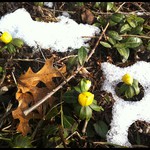
Seven: The thrill of the first crocuses. We may not have daffodils yet, but this weekend my entire family (and a few neighbors) gathered reverently around this sacred bunch.

IMG_0124

Take that, brown and white. Purple and green have returned!

And Eight: Open windows. In the fall, 50 degrees means bonfires and hoodies; in the spring, we roll down car windows and play our music for the world. Just the other day it was 60 degrees, so we aired out our house, missing the irony that our thermostat is set for 68. No matter–spring is coming, open the windows and let it in while you can.

Stir-crazy is a type of crazy, and I’m not sure I can be trusted. Soon I’ll put our glove basket away and replace it with swimming gear. Soon I’ll put away the soup pots and get out the picnic blanket. Soon I’ll trade mud boots for flip flops, or even better, bare feet. I’ve lived in Western Pennsylvania long enough to know that I should probably wait a few months for these rites of seasonal transition, but we’ll see.

It’s snowing today. Maybe I’ll wait until April.


Photos by Ryan Marsh and Dan Buczynski
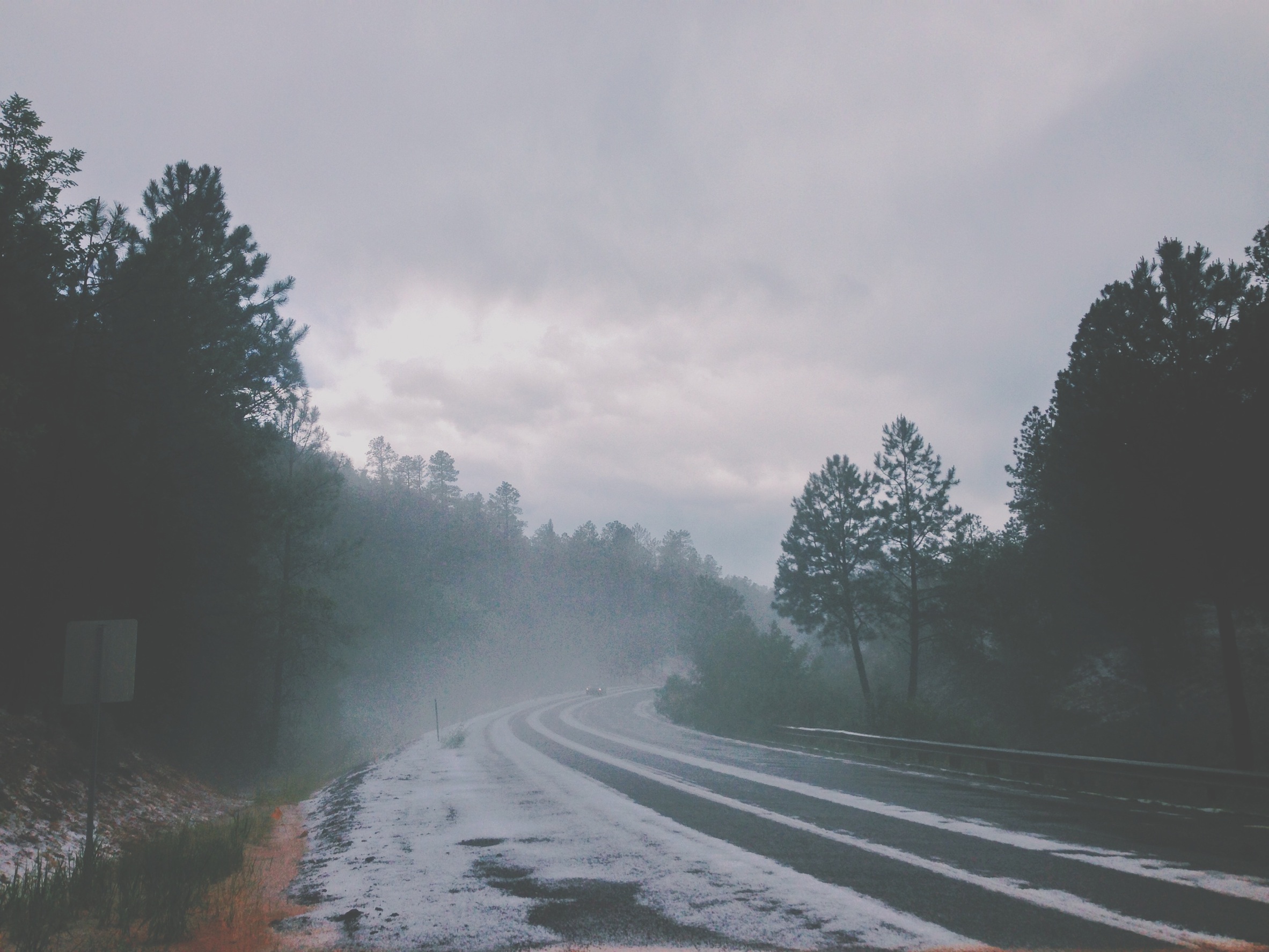
Winter Road

Here is something I found to be true: You don’t start processing death until you turn thirty. I live in visions, for instance, and they are cast out some fifty years, and just last year I realized my visions were cast too far, they were beyond my life span.” – Donald Miller, Through Painted Deserts

I’m not quite at thirty yet. I turn 27 in May. I’m not exactly contemplating death, but is has become less of an abstraction. A sound I didn’t think would accompany my 20s is a constant companion: My day is filled with the hiss of air. Not a cold blast blowing down from the Blue Ridge Mountains, but a purer kind of winter air, the kind run through a rubber tube to my father so he can breathe easier. The constant hiss of the air being pushed into his lungs is a reminder—a tangible metaphor of the end that is approaching us all.

Like many of my peers, I am out of college, unemployed and living at home—though my situation isn’t quite the norm. Instead of spending my days job searching, I sit at home and goof off on the internet. (Ok that’s typical of people in my situation.) At least that’s what I do until my father gets up and I roll his oxygenator into the living room and remind him to take his pills, check his blood sugar and then get him breakfast.

I don’t know many in their twenties who have to confront the mortality of a parent, at least not in the way I do. My seventy-nine year old father sits in his chair pretty much every day now and reads and watches TV. We are at opposite ends, he and I. I’m longing to be fully into the summer of my life, waiting for a career, a wife and perhaps a family; while he sits near the end of his life, his career gone and his family scattered around the country.

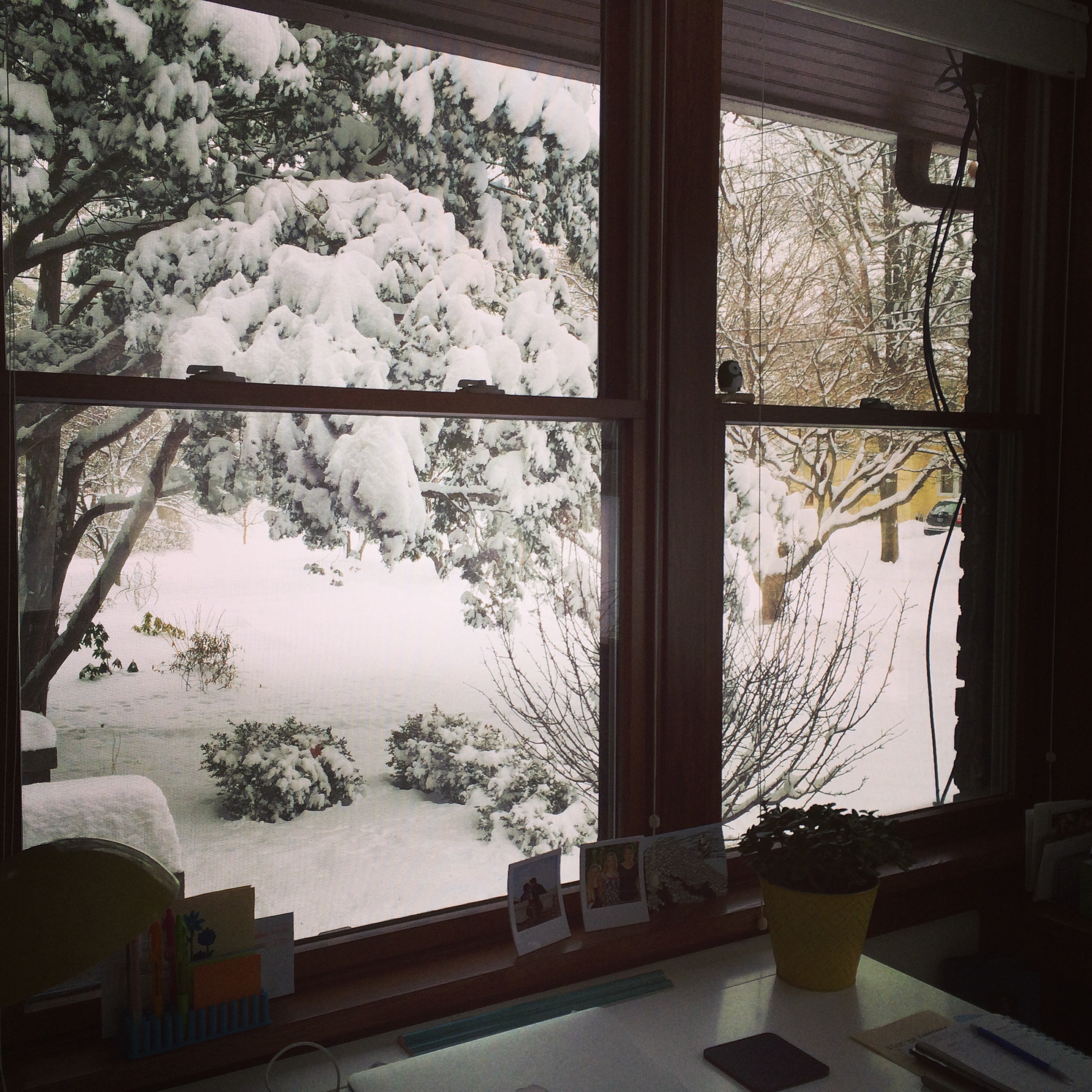
I worry about so much these days. It’s a suffocating feeling to be trapped in a space you feel you can’t get free from. My father feels much the same way, especially being stuck inside for the Winter Roadwinter months because of the cold. Yet, he doesn’t worry like I do. “God has a plan,” he says. “Maybe, I don’t know if I trust it though,” I reply. If I were in his position I would not be as calm and trusting in God. But throughout it all my dad has kept this serenity about everything, despite age and health conspiring to bring him down.

It used to be I thought thirty was old. Now I look at people in their fifties and think, that’s not so bad! I worry about my next fifty years and what will happen, and it’s then I remember that if I should last that long I’ll be almost the same age as my father is now. I look at him and wonder if my life will follow a similar script. We are alike in so many ways; both of us a bit stubborn and yet willing to discuss and debate everything. And yet, I wonder if I will be as serene when my own winter comes.

It was at thirty-eight that Robert Frost wrote, “Stopping by the Woods on a Snowy Evening.” At that age, he was just 20 years before the end of life expectancy for people of that time. Looking out his window, he knew that the spectre of the end was creeping up on him. But at a time when most of us would be in a mid-life crisis, he was less concerned, talking about his promises to keep and miles to go before he slept. It was just six years before he wrote “The Road Not Taken,” which ends like this: Two roads diverged in a wood, and I – I took the one less traveled by, And that has made all the difference.

As I sit on the couch I look at my father, knowing he’s tried the road more traveled by, a life without God and supposedly without consequences. He returned to the narrow lane when he returned to his faith. I have to agree with Frost: It has made all the difference—for him and for me. Without it, this last phase of his life would be much colder and more of a struggle.

I think when you’re younger the road more travelled seems like the best option. I’ll admit I think about taking it instead of the narrow one. But when I look at how calm the winter of my father is I know it’s the wrong choice. Taking the narrow road will always be unnerving. There are more obstacles in your way, sometimes you must choose between honesty and success, your integrity or comfort. But if you’re lucky, the weathered signposts will be there—the ones put up in the winters before you, with the handwriting you know so well. That is how you know you’re on the right path.

* * * * *

10387502_685529957081_2815207386496696502_n“Winter Road” was written by Michael Hadley. Most of Michael’s time has been spent migrating between Chattanooga, TN for college and Asheville, NC where his parents live. For a semester he lived between the communications department, Starbucks, and Barnes and Noble; his addiction to books and coffee is what drives him. Currently he is freelancing in Asheville, NC and Chattanooga, TN hoping to find a “real” job. His work can be found at MichaelHadley.org and his wit on twitter @MCHadley

Baby Season

I dreamed last night that I had a brand-new baby girl.

The dream wasn’t all snuggles and coos—it definitely included some bizarre elements, as dreams do. I was, for instance, somehow surprised by the arrival of this baby, even though it seemed clear in the dream that I had given birth to her, not adopted or found her wrapped in blankets in a cardboard box on my doorstep. My level of surprise about the baby was palpable in the dream, but I knew enough to hide my astonishment from others. I calmly went along caring for her and showing her off to friends as if I, too, had been expecting her all along.

Because I wasn’t actually expecting this baby, Dream Me had to improvise a bit to get her properly clothed and geared up. A significant scene in the dream involved me pulling big plastic bins off a top shelf in an enormous closet to look through the clothes my two real-life daughters wore as newborns.

One such bin exists in a (much smaller) closet in my waking life. It’s filled with the tiny shoes, Easter dresses, and footed pajamas deemed Most Special, along with handmade gifts like the pale blue cardigan my grandmother knitted for my firstborn, with its kitty-cat buttons and row of silhouetted white cats along the border. But in real life, I haven’t looked through that bin for probably a decade—not since that moment when I somehow knew my baby days were over, prompting me to sort all the little clothes into two piles: items to pass along to friends having babies, and favorite treasures to carefully pack away and keep.

When I woke from the dream, I was filled with longing, love, and loss. This might not seem at all surprising to most people, but it completely surprised me. I have never been a woman who longs for babies.

Of course, an entire season of my life was devoted to babies. It’s a season I treasure and wouldn’t trade for the world, but mostly because it is a necessary season for all who want to have children who will some day not be babies. The Baby Season was simply the first stage of parenting—the inevitable season leading to all of the seasons that follow.

*   *   *   *   *

Every parent, if they’re being honest, will admit to having favorite (and least favorite) seasons of parenting. Yet somehow I’ve always felt guilty for not being baby-crazy. It’s almost as if not getting the “uterus aches” that other women talk about when they see newborns knocks your womanhood status down several notches and calls your maternal instincts into question.

Don’t get me wrong—I loved my own babies fiercely. (For those of us who are not “baby people,” our own babies defy that category). But I don’t remember thinking “I never want them to grow up!” I loved the experience of nursing my babies (and I did nurse them each for about 13 months—does that earn me extra credit?), but I don’t recall a heart-rending pull as my babies began to rely less on my milk, eventually weaning without a fuss.

Instead, I was happy to see them grow into unique little personalities, with opinions and relationships and senses of humor. I loved watching them develop friendships and put feelings into words as toddlers, then problem-solve, create, and become more independent as they ventured through their preschool years.

During my daughters’ elementary school years, I was forever fascinated by the glimpses of myself and other family members I saw in my girls, and was equally fascinated by the many facets of them that seemed to crystalize out of nowhere. And the ways my two children are different from each other—two girls created from the very same gene pool!—has never ceased throughout the years to be amazing, refreshing, and challenging all at once.

*   *   *   *   *

Today my daughters are 17 and 14, both in high school. There’s no doubt I’m in a different season of parenting. Along the way I’ve loved many of the stages—six and 18 months were ages I savored, along with their preschool and mid-elementary years—but I have to say the particular season we’re in is one of my favorites. It’s also possibly the hardest (teenage girls!). And it has occurred to me several times that those two opposing feelings—the love and joy as well as the stress and challenges—are in fact intimately bound together. Everything is intense, on both ends of the spectrum. Preparing girls to go into the world as women, sure of who they are and what they are capable of, is no small task. It’s both exciting and difficult, like all of the best adventures.

And as I consider last night’s dream, I’m also realizing how very bittersweet this season is—much more so than I want (or have the time and emotional space) to admit in the day to day. It’s more bittersweet than weaning my babies, or packing their tiny shoes away into plastic bins.

Yes, as parents we’ve been preparing our daughters for independence all along, but these are the years when it gets real—not only in how their experiences and our conversations will prepare them for what’s next, but also in the ways “what’s next” will impact me. I can begin to envision a time when our household won’t strain at the seams to contain the whirlwind of kinetic energy that exists between 6:45 and 7:45 each morning; when the pile of shoes by the front door will diminish in number as well as colorful variety; and when the dishwasher won’t be packed full after a single family dinner with everyone at the table.

photoIt’s true, I’ve never wished my daughters could remain captured in a state of babyhood. But they are still my babies. No matter how grownup they become, they’ll still embody all of the love and longing of the seasons we’ve been through. And as we rush through these final years of childhood, the baby in my dreams reminds me that it’s OK to pause—to long to bundle them into footed jammies and enfold in my arms.


The Sunshine State

Florida has two seasons: summer and January. And flip flops can (and should) be worn during both.

Cradled between the Atlantic Ocean and its more laidback cousin, the Gulf of Mexico, it quietly putters along while the states above it tromp through seasons and mark time in the usual fashion. Like Peter Pan’s Neverland, Florida is a green, sun-soaked playground where April is indistinguishable from October and a staggering array of flowers blossom year-round between gumbo-limbo trees and cabbage palms.

Jax BeachTo a nine-year-old child like me, born in the grubby northeast corner of Arkansas, Florida was a revelation—a land of limitless azure skies filled with cotton candy clouds and a salt-tinged breeze. I spent days hunting for sharks’ teeth at Venice Beach, trail riding through acres of slash pines and saw palmettos (always on the lookout for fat yellow spiders), tubing the Ichetucknee River, and prospecting for balls in the water hazards that dotted the state’s ubiquitous manicured golf courses.

Though I grew up, the landscape changed much more gradually than I did. Sadly, once empty property is now filled with the ubiquitous, inescapable trappings of modern society—chain restaurants and grocery stores. Gas stations and home improvement warehouses. A Starbucks on every corner. But my elementary school, the place where I learned about Seminole Indians and fell in love with C.S. Lewis’ The Chronicles of Narnia, is still there, a larger parking lot and bike corral its only signs of growth.

My grandparents’ home is still there too, a two-story structure of weatherworn bricks surrounded by a sun-bleached and slightly warped wooden fence. It’s the place where I perfected my backstroke in their kidney-shaped pool and lazed away the afternoon on a lounge chair, a bowl of Schwann’s rocky road ice cream in my lap. The place where we celebrated countless Christmases and birthdays and where my aunt and uncle—and later my husband and I—were wed by my great uncle James in front of the coquina fireplace in the living room.

In a state where the Fountain of Youth burbles away, The Mouse still turns a brisk trade in his Magic Kingdom, and the seasons never change, it’s all too easy to forget that time isn’t a renewable resource and that, for everyone who lives there, it will eventually run out.

Between the home I love and the school I remember is a small structure—one that has served both as a law office and a police sub-station. But it is now an assisted living facility for people who have dementia or Alzheimer’s disease, and my grandfather is one of the people who calls it home.

Like the beach he once enjoyed, which is siphoned grain by grain back into the sea, he is being pulled away from us by the tide of time. And there is no regaining what has been eroded, no reclamation project that can bring him back. It’s a hard truth to witness in a place filled with the delightful lie of endless sunshine.

I now live in Georgia and experience the passing of time as others do—season by season. Summer lingers longer here than it does most places, and autumn is far shorter than I’d like. There is winter too, a span of months where leaves wither and fall into doleful piles, leaving their trees naked and exposed to the same cold winds that slice through my bones no matter how many layers of clothing I pile on.

But because I experience those bitter months, I’m all the more appreciative of the spring that is sure to follow. I want to cheer when the Japanese Red Maple in my front yard once again dons its ruby-colored cloak and my husband’s bees begin the work of restocking their hives. Witnessing it all has helped me accept that for everything there is indeed a season, a time for everything under heaven. What is born will die. What is planted will be plucked up. I will weep and mourn at times, yes, but I will also have cause laugh and dance again. And one day, I’ll live in a land that knows no seasons and where death no longer holds sway.

*   *   *   *   *

Jamie A. Hughes“The Sunshine State” was written by Jamie A. Hughes. Jamie is a writer, editor, and unapologetic St. Louis Cardinals fanatic who currently lives in Atlanta, GA with her husband and two needy cats. A former high school teacher, she now works as the managing editor of In Touch Magazine and is struck dumb by her good fortune. She blogs at tousledapostle.com and can be found on Twitter @tousledapostle. 

Apples and Honey

I have never been much of a gardener, nor someone who relishes yard work and the natural rhythms of planting and harvesting. This is probably because in the first decade of my adult life I moved five times—in four different countries. Occasionally my apartments might have hosted a few pathetic geraniums, but both physically and metaphorically, those years were not ones in which I was “putting down roots.” I was a traveler and a missionary, perpetually single, and free of family demands.

Free too, of the connection, rootedness and sanity that comes with being cared for within a family day in and day out.

One particularly lonely September I was teaching in Lithuania, feeling as forlorn and shriveled as the last brown leaves clinging to northern European trees I didn’t even know the names of, when a friend brought me a bag of apples from her family’s trees. She also brought me a jar of dark-colored honey, a small portion of a gift she’d received, more than she could eat on her own.

Putzing around my kitchen that weekend, I decided to see what I could cook with apples and honey. Finding a recipe for apple-honey cake on a webpage devoted to Jewish cooking, I discovered that apples and honey are traditionally eaten during the Jewish New Year. Together, they are meant to symbolize the hope of sweetness in the coming year. My friend had unknowingly brought me apples and honey mere days before the September High Holidays of Rosh Hashanah and Yom Kippur.

Psalm 81 is a traditional Psalm of Rosh Hashanah, during which the shofar trumpets are blown and God reminds them: “I am the LORD your God, who brought you up out of the land of Egypt. Open your mouth wide, and I will fill it.” Of all the things I expected from that coming year, I could not, in the particularly grey autumn of single almost-30, have believed that an apple-honey cake held any hope for sweetness ahead. Hope was running very thin, and after many years of missionary sacrifice and relational disappointments, I suspected that when God commanded that I open wide my mouth, I would be getting bland, dutiful manna, not honey.

Nevertheless, the end of Psalm 81 promises:“He would feed you with the finest of wheat, And with honey from the rock I would satisfy you.” Where a Protestant might just see ingredients, a Jew sees promises, so I baked my cake, invited friends over to share it, and tried to muster some belief that what lay ahead would be sweet.

But it wasn’t.

The grey, both within and without, got a lot greyer, and that northern European winter was colder than it had been in decades. I learned how to wear loneliness like a tattered coat. I moved back to the States before the next school year and took the least-missional job I could find. It was a difficult, wrenching, decidedly non-sweet year.

And so was the next. The year after that, thanks to counseling, sunshine and exercise, was a little bit better.

The year after that I got married. I moved into my husband’s house in Colorado and discovered that amongst the twenty trees on our lot—mostly locust, maple and aspen—there are two apple trees. They take some serious effort to maintain. They have to be pruned and shaped, watched for fire-blight. When overripe apples fall on the lawn, they rot and kill the grass. In September we spend several weekends on ladders, shoveling the bounty of apples into box after box, giving them away to friends, coworkers, neighbors, and whoever will take some of the abundance off our hands.

Each year, I’ve made the apple-honey cake again, in an old yellow Bundt pan. I grease the pan liberally so the sticky batter of apples, spices, honey and brewed coffee will come out clean and brown. Last weekend, I pulled one of the gallon-sized Ziplocs of sliced apples from my freezer and made the cake to take to friends who just had their second baby. As we ate it together, our son and their daughter chased each other around the kitchen.

I don’t quite know when I first felt these new roots taking hold. My personal story could have just as easily continued to be one of perpetual motion, but somehow instead, I’m living in the suburbs, learning how to care for fruit trees. Instead of feeling like a single, severed branch, I live in a rhythm of seasons. There is honey and sweetness. But I know it is, as the Psalm says, honey from a rock, sweetness that has been wrung from hardness. And sweeter for it.

*  *  *  *  *

J Fueston Photo 2“Apples and Honey” was written by Jennifer Stewart Fueston. Jennifer writes in Longmont, Colorado where she lives with her husband and young son. She has taught writing at the University of Colorado, Boulder, as well as internationally in Hungary, Turkey, and Lithuania. She recently published a chapbook of poetry, Visitations, with Finishing Line Press. She blogs very sporadically at jenniferstewartfueston.com and has just realized she uses Twitter (@jenniferfueston) primarily during playoff football.

The Fullness of Fall

 Everything dies. Nothing dies.
That’s the story of the Book.

It’s like this for me in Texas: fall is when love blossoms only to die in the spring.

In the fall, the air is fresh. The promise of cooler weather is heralded with storms rushing from the north. The grey winds from afar release the death grip of the Texas summer heat. The fall is football, Friday night lights, and the romance of a dying summer. It is a chance to actually enjoy the outdoors again, and a reminder that Texas is still a great place to live.

Autumn with its too-muchness,
Stretching the boundaries
Of Song

Fall is full. The wounded red of fall drips from the trees. There is an aching in the shadows of leaving trees, and even the very slant of autumn light stirs my overly romantic soul.

I once kissed a girl on a fall night after a heartbreaking home football loss. It was my first kiss. We were out under the October stars, still warm enough to only need sweatshirts as we lay looking up at the eternal markers. I am not sure I have ever been more scared. I am sure I have never been happier.

In a Texas spring the weather is violent. It unleashes furious storms, snows in the middle of a perfect week, and then hints at the hated summer heat. The wildflowers come roaring along Texas highways bursting forth in strokes of crimson, yellow, and blue. But their life is doomed by the coming heat. Aborted beauty burned up like martyrs holding out against the summer’s tyranny. Even the spring’s green brings with it an awareness of the brown it will turn to in the overbearing sun.

I was heartbroken by the next spring. The first kiss in the fall turned into a last parting kiss on an April day. A Friday, holding her at the door, my first broken heart left exposed before the summer heat.

**********

Others in the north will speak of seasonal depression hitting them during the long winter, but for me, the weeks of early spring, the lenten season before easter, is when it comes. For the past 7 years, I have waited ominously through spring for it to strike. Sometimes it does not arrive, but sometimes it does as the creeping nausea of blank feelings emptying my heart of any joy.

Several years after my first broken heart during my last spring semester in college, I met this girl with burning blue eyes. I fell for her like a boy lost at sea, but she was unable to return it. Another spring romance born only to die.

The wave of depression that followed was one of the worst I have known. The weeks of late March and early April nearly crushed me. I could hardly breath much less attempt to write my senior paper, and I almost failed my last class at Texas A&M. It was the first time in my life where I fully felt the need to take a pill.

For the last three years I have attended an Ash Wednesday service during February before spring could come. It has been my bulwark against spring. I would like to think the reminder of my death, the passing from dust to dust recalled in the service, protects me with my own weakness. We are dying, yes and amen. On Ash Wednesday there are no false promises.

**********

I read the Book for years
And never understood a word.
Scrawled in its margins.
Wrote my own versions
Of what I read there,
But never got a thing right.

Didn’t understand that each
Poem was a magic spell.
Was a voice,
And under that voice: an echo
That was the spell

As if each poem clearly spoke
The word “Death”
And the echo said “Life.”

And this is why I love the fall: it is full of death, but its echo is life. Roiling under its scenes of dying, I often sense the true vibrancy of life. Amidst all the life of spring I am too aware of its coming end, but in the fullness of fall heaving with death, I hear what sounds like a symphony to my soul: the oblique cry of life like an echo from an empty tomb.

(All quotes are from the beautiful poetry collection Concerning the Book That Is the Body of the Beloved by Gregory Orr)

Seasons Don’t Change On Time

Southern California doesn’t really submit to the whole concept of “seasons.” Southern California has 85-degree weather whenever it feels like it, which is about 11 months per year.

The 30-or-so days of cloudiness, chill, and sometimes even rain that we do receive annually are spread out in seemingly random two- or three-day sets throughout the year. There are inevitably  a couple of “unpleasant” days around Halloween, just enough to make people worry about outdoor carnivals. Then, usually a few days in March, which are generally welcomed because they bring out the bright yellow daffodils in time for my birthday. Of course, around Christmas when we would love to enjoy a hot holiday drink from Starbucks and a rainy day, we can’t find a cloud in the sky or any temperatures below 75 degrees. Find us in California struggling to enjoy iced pumpkin spice lattes. It’s just not the same.

I’ve lived in Southern California for my whole 26 (almost 27) years of life, and I continue to be caught off guard by the unpredictable, albeit lovely and temperate, weather here. I allow myself to be caught up in these idealistic concepts of what the holiday season or springtime will be like and then find myself so often disappointed when it’s too hot to take a springtime walk or there are no such things as snowflakes for 100 miles in any direction from my house. And then every once in a while, right when I think “It’s always nice in June,” I’ll plan a barbecue and it pours rain for a few hours and we have to move inside. That’s the rare case, but it just goes to show me that I can never be sure what is coming next.

ca seasons 6This Groundhog Day, February 2nd, reminded me yet again that our weather never follows anyone else’s rules. On the one hand, Punxsutawney Phil saw his shadow, which predicted six more weeks of winter. On the other hand, California cares nothing for Pennsylvania’s predictions  about our weather, and we had our first 80+ degree temperatures of the new year. The calendar says it is supposed to be winter until March 21, but here, we already look like summer time with our shorts and hammocks.

As I joked with my coworkers about the heat wave in February, I recognized for maybe the first time that there could be something profoundly beautiful about the fickleness of the weather. Maybe I could appreciate that seasons do shift, even when it is unpredictable. Perhaps there could be rejoicing in the knowledge that unexpected disappointment may sometimes skip hand-in-hand with unexpected excitement.

In a similar way, at some point during my 20s I had determined that this season of my life was supposed to look a certain way. I used to expect this to be the springtime of life, when things are all rose gold and princess cut and little pink lines. When things didn’t fall into place for me that way, I thought, “Well, then, it must be a season of winter!” I could choose contentment in the paycheck and the late night drives with friends for no reason and having enough time to take voice lessons.

Just when I think that I’ve nailed things down exactly the way they are, it’s all changing again. All of a sudden my life is full of daisies and gleaming sunlight and exhales that turn into smiles without my permission. Perhaps I will never figure out what’s coming next, in my life, or in the Southern California skies. Maybe I’ll learn, though, to embrace  the uncertainty and pick daffodils to collect on my table while they are blooming.

*   *   *   *   *

SarahLpic“Where Seasons Don’t Change On Time” was written by Sarah Rose Lochelt. Sarah is a Southern-California native who works at a local Christian university near her home in Glendora. She studied youth ministry for her Bachelor’s degree and counseling ministry for her Master’s degree, and wishes she could get paid to read books for a living. On any given day, you can find her choosing food based on texture, laughing until she cries, and commenting about how “the book was better than the movie.” She blogs, and also writes movie reviews for Mike & Rusty’s UK site on the side.

Tough Seasons

I’m just in a tough season right now.

For awhile in recent times, this was my “real” answer to the question, “How are you doing?”  To my mind, it communicated that the current load was heavy and awkward, but that I knew it wasn’t going to be like that forever.

But then, trying to encourage a friend who was wrestling with a series of deeply challenging events, I muttered something along those lines, “Whew, you are in a really tough season.”

And she pushed back.

“What if it’s not a season?  What if this is just the way that things are?”

Gulp.

I took pause. She might be right.


I have lived the scene in the movies where a bunch of friends wearing overalls and headscarvesMP Under Magdalene fix up a run-down property and fill it with love. With four other friends, I founded a charitable non-profit at the wise old age of 22. During the construction phase, we had long circular conversations about how to handle potential problems. But soon, the doors opened and time for long conversations was gone! Real women with real problems began to move into the home. Our mission of welcoming homeless pregnant women was set into motion.

Suddenly I had to make important decisions as a part of my daily life—decisions that affected the well-being and living environment of the people in my life. Freshly out of college and a natural peacemaker, the reality of constantly angry or disappointed people rocked my world. As the leader of this project, I was forced into difficult conversation after difficult conversation.

To a mom: “I’m sorry, we are asking you to leave. I know you don’t have anywhere else to go but your behavior was unacceptable. For the good of everyone, this is the decision that I’ve made. I’m sorry.”  Her response: hardened silence.

To a neighbor: “I would love to have a calm conversation about this and figure out a workable solution. This is our home now and we want to be good neighbors.” Her response: filing complaints with the fire marshall and the zoning department.

And on and on and on.

I was a very young soul fumbling to shoulder a very big responsibility.

A potential donor came by for a tour of our program. As he left, he turned to me and said, “One day, running one home will be easy.” I smiled and nodded, keeping a polite “Yes, Mr. Donor” face. Inside, I was fuming. THIS could never be easy.

My internal experience of that time was one of sheer emotional weight—the feeling of having no choice but to bear something beyond my capacity, something completely and utterly unbearable.

I was holding it together and doing what needed to be done. I was putting on my best “I am a competent leader” face when it was needed. But deep down, I was overwhelmed, alone, and scared.

But, even so, I did bear it.

Free from consequences? Nah. With perfect dignity? Nope.

Nonetheless, I did learn to shoulder the responsibility, to carry the weight.

And as it turns out, the donor was right. Eventually, I was able to bear the load of more than one house. And looking back, the responsibilities of leadership in those early years now seems small in comparison to the responsibilities of the later years.


So, thinking about “tough seasons”… perhaps my friend going through a tough time and I were both right.

Life is hard. You say things you wish you could take back. You experience betrayal and disappointment and grief. You have to deal with things that you never wanted in the first place. Dreams and reality collide. Plans shift and sacrifice stings.

But, you live your way through it.

And seasons change.


On the threshold

I was born on the threshold of spring—at that moment when winter could just as easily dig in her heels as bow graciously and take her leave.

Over the years, the second day of March has skipped, tip-toed, sloshed, or trudged onto the scene of my life, accompanied by a wide variety of backdrops. Some years, the snow completely melts by then, inviting me to joyfully lace up new sneakers in place of clunky boots, and to take my coffee out to the porch.

I remember one spring-like childhood birthday in particular, because it was nice enough outside to go for a spin on my new birthday bike—a yellow banana seat Huffy with orange and white accents, called “Texas Rose” (bikes came with names back then, written in a suitable font across the chain guard). I still remember the clichéd-but-very-real freedom I felt as I pushed hard on the pedals to pick up speed, the wind lifting my bangs off my forehead and the handlebar streamers blowing back, tickling my arms. Even the puddles, spraying a mist of grimey specks onto my pants, were a joy to whiz through: The sound of bike tires cutting through puddles was the music of spring. Back in our driveway I engaged the kickstand, my Michigan winter legs trembling in response to the sudden demand placed on spring-and-summer muscles.

photo (8)Other years (like this year, for instance), heaps of snow have cruelly set my birthday scene. By early March everyone, of course, is longing for spring, but I tend to take its coy absence personally. I would gladly exchange all my birthday presents for an early departure of winter—for a walk on non-treacherous sidewalks in the sunshine, hat- and mitten-free, with the first signs of daffodils poking up through dead leaves. What could be a better gift than a promise that temperatures won’t fall below 50 again until fall?

unnamed-2Instead, the likely reality in early March is something in between—neither here nor there, winter nor spring. In March you can often find me walking on the north side of the street, where the longer days of south-sweeping sunshine have melted the snow into slushy puddles and coaxed snowdrops, aconites, and crocuses out of hiding.

Soggy grass and brave flowers on one side of the street, dirty piles of snow and icy sidewalks on the other; I walk through March balanced in an awareness of what has been and what is to come.

*   *   *   *   *

As if taking a cue from the month of my birth, I tend to live my life at the intersection of realism and optimism—with an acute awareness of what is, but also a vivid understanding of what could be. The truth of the matter, as well as the hope. The now and the not yet. The lion and the lamb.

I grudgingly see the dirty piles of snow for what they are, but I know they’ll eventually become water to nourish flowers and lush green grass. The messy pile of boots by my front door, and the puddles and salt deposits they leave on the wood floor, will undoubtedly be replaced by sneakers and flip-flops, grass clippings and leaves.

unnamed-3And the weight I feel—whether from so many layers of clothing and gear, or from built-up deposits of worries and regrets—will melt away, just as surely as the clouds will disperse and warmer streams of air will travel my direction, crowding out the chill. Suddenly, one bright morning, I will be able to see again who I am under all those layers of down and wool, and wondering and longing. I will see that I am a new creation, in process, again and again.

Chicago was spring, Philadelphia Autumn

I am sitting in a guest room that was once my room at my parents’ home. I’m typing away with my feet propped up on a box and my computer on top of an antique vanity that belonged to my great-grandmother. The years have cycled back, the way they do, to the first season. The room is mine again.

The red Georgia clay and the bare winter limbs on the oaks outside are part of the season that birthed me 32 years ago. I joke with my parents that I am the poster-child for the boomerang generation. Three cross-continent moves, a graduate degree, and a couple “adult” jobs under my belt, but here I am typing away at a vanity where I can see my name that I etched into the wood as a kid.

On my first cross-country move I landed just north of Chicago, a ten-minute walk from the shore of Lake Michigan. It was a land of straight and flat roads, crossing at hard-right angles until you got to the shore where sand and rocks met vast water. I had a spot near the lake—a tree arched over the edge of the water and every season I marveled at the changes there. I once waded waist-high in snow drifts to get close to the icy lake. I watched in awe as the weather changed from week to week. For the first time in my life I knew what it was like to ache for the coming of spring, to see the green shoots of grass start growing as the slushy, dirty snow finally melted.

In Chicago, the beauty of the Lake and the beauty of the architecture fed my soul in tandem. Chicago introduced me to myself in a way that’s only possible when you flourish somewhere brand new. As a suburban girl, I barely knew my neighbors, but here I passed them on the sidewalk regularly as we all walked to the train or the coffee shop or church.

When spring came, we all went outside. The two elementary school children across the street played football with their dad in the front yard, Henry the beagle and his caretaker made frequent trips around the block; I chatted with the next door neighbor about plants as I edged my lawn right next to her driveway. There was an annual block party and an Easter-egg hunt. My introverted self means I can’t tell you the names of many of these people, but I was drawn to the community and togetherness–these seeds of community burrowed into my heart.

And when the season in Chicago was done, I landed in the hills and valleys of Eastern Pennsylvania to attend seminary. Here, I would check the weather for rain and plan my life accordingly. When it rained the basement flooded and blocked my path to the washing machine for a day. The roads flooded in such a way that my old car protested and sputtered over every puddle.

But on pretty days I’d sometimes find myself on a hill in the beautiful Valley Forge National Park, textbook and pen in hand as I did my reading for my seminary coursework. During those years the theology I studied and learned began to stitch together the pieces of my life. I was desperate to know if I was changing, or just growing. Had my years as an educator and a non-profit worker,  my experiences as a single woman and a fat woman, my understanding of God learned in a suburban Southern church and an urban Midwestern church  finally all come together to produce who I was?

That last year in Pennsylvania was a bountiful harvest. I had seen the beauty of community while watching my Chicago neighborhood, I got to live it in Pennsylvania where every Sunday night neighbors gathered together for dinner. Relationships were deep and meaningful. Ideas and hopes and dreams were always close at hand. After a lifetime of not knowing what I was passionate about, I finally had answers (to some things!). There were places where I could voice a firm “yes” or “no.”

Those passions and ideas unexpectedly led me back to Georgia, a move not for work or grad school, but a choice to be near family. There is a lot that is uncertain for me about life back in Georgia. While I found a worthwhile reason to move, one that was born out of the community I experienced with people who had been strangers,  my current situation lacks the structure to define my day’s activities. There is a freedom to find what will shape my life here. It is planting season: time to sow the seeds I reaped from a Pennsylvania harvest, first nourished in a Chicago spring.

The dark wood of this old vanity and the even-older red clay outside remind me that there are roots already here. This very specific plot has nurtured my beginnings before. A harvest will come again.  Now, counting on the hope of spring and the bounty of autumn, I sow.

* * * * *

fall“Chicago was Spring, Philadelphia Autumn” was written by Nicole Morgan. Nicole has lived near Chicago, IL; Philadelphia, PA; and in a handful of lesser known Georgian towns. She loves discovering, and falling in love with, the parts of these communities that make them unique. She currently lives in her childhood home near Atlanta, GA, writes about bodies, theology, and community at jnicolemorgan.com  and tweets away @jnicolemorgan