Between here and there

Going home, for me, involves many of the cozy things you might expect—fires in the fireplace, my mom’s apple pie, snow falling outside the windows while we play board games late into the night. But for the past decade, being at my parents’ house in Michigan has also involved hours spent in a place where I feel least at home: Among the dying.

Yes, we’re all in the process of dying—we walk every day among the living and dying. But death feels so much more palpable and impossible to ignore in the nursing home where my grandmother lives. Grandma turned 100 in May, and is no longer strong enough to make it out of her button-controlled bed into a wheelchair and then into a car for the 15-mile trip to my parents’ house. All of our visiting with her now happens at the nursing home, where nothing smells right, sounds right, or feels at peace.

Last week we visited her on Thanksgiving, a piece of pie in hand to sweeten her day with a taste of home. Grandma was sitting in bed asleep, a spoon still in her hand and dots of bright, abstract chili splatters marking her “bib.” She still feeds herself (mostly, if she can stay awake), she still exercises, pedaling a bike-like device with her hands, and her mind is usually surprisingly sharp.nursinghomeroom

Still, Grandma is 100. It took us a while to wake her up enough to see a spark of recognition in her faded blue eyes, as my dad gently removed the spoon from her hand, dabbing at a bit of chili on her chin with a napkin dipped in her water glass.

As we chatted, we raised our voices to an unnatural level, allowing us to be heard above the TV on the other side of the curtain. At this volume, we were loud enough to attract the attention of Grandma’s roommate Leta, who is tireless in her attempts to get in on our conversation. Leta has Alzheimer’s, and while we hate being rude, engaging her is like opening Pandora’s box: There is no end, which only makes Grandma grouchy. We are her family, and she wants our full attention. We want to give it to her, too. Each time we end a visit, as I kiss Grandma’s cheek goodbye and smile into her eyes, I am forced to inwardly acknowledge this might be our last visit.

*  *  *  *  *

I have never gotten comfortable with the idea of death. Of course, I have plenty of company in that place of discomfort, especially here in America. But even though my aversion to death is common, I’ve still always felt a certain amount of guilt about feeling this way.

The guilt, I suspect, mostly stems from being raised in the church, where there was a sense that, as Christians, we were supposed to “long for heaven”—that heaven was our true home, and God was our true father, and anyone who wasn’t praying for Jesus to return and whisk us all away (somewhere up in the sky with gold-paved streets) was probably not a true Christian.

While death is something I avert my eyes from, aging, so far, has been a good thing. I like being wiser and knowing better who I am with each year—feeling more and more comfortable in my own skin as time passes. I was surprised by how easily I embraced turning 40. It was a celebration of making it through so much and finding myself on the other side more whole and happy than I had ever been. But I assume there is a tipping point, a moment when growing older ceases to be an unfolding and begins to fold back in on itself—a realization that my body doesn’t work like it used to be, and that chronic pain has the power to eclipse joy.

*  *  *  *  *

For now, though, my family is young and we carry that joy around in us, like a bright light that emits warmth for others to bask in. Taking that joy to my grandmother’s nursing home may not be fun or comfortable, but it is our responsibility, even as we long to shrink away from the sights, smells, and sounds of the old and dying.
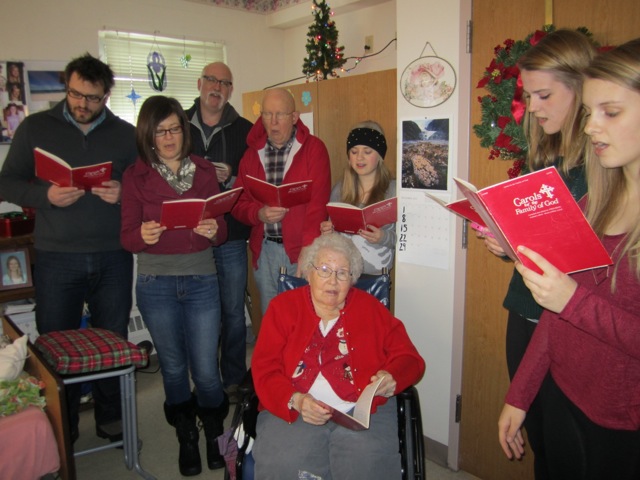
carolingpicIt has become our tradition when we’re in Michigan for Christmas to sing carols up and down the halls of the nursing home, pushing Grandma in her wheelchair at the front of the parade, where she feels like queen for a day. When she was young—even well into her 70s—Grandma’s trained voice was a beautiful soprano, and she played the piano like a dream. Now, when her family is surrounding her, making music in four-part harmony, Grandma is as close to heaven as she will get on this earth.

We pause and sing for a while to a group of people sitting in the lobby just outside the dining hall. As we finish singing and turn to go, wishing them a Merry Christmas, several of the residents reach out to touch our hands—especially the hands of our three teenage daughters, so young and soft they seem to radiate goodness powerful enough to be contagious. Others seem to have forgotten us, lost in reverie. Their eyes are misty with tears, focused on a faraway spot that takes them beyond the nursing home, beyond place and time. Here, we are all out of place in our own ways, suspended somewhere between young and old, life and death, the now and the not yet.
Mourning

It was the evening of October 18th, 1985. I remember the exact date, because I had accompanied my (then) boyfriend, Tom, and his mother to a Tex-Mex restaurant to celebrate her birthday. Tom’s mom and I had spent little time together during the two years I had been dating her son. I felt as buoyant as the bright, helium balloons hugging the ceiling of the cantina. At the same time, I was nervous and anxious to please. Mrs. Phillips was a “proper” Southern lady.

Later that evening, Tom and I—his mother was not with us—were sitting on his ugly, sturdy couch striped in bachelor-brown colors, when he declared: “Well, I guess we ought to get married.”

There was no kneeling or “prithee,” but a decisive suggestion by this man who had been pegged by his friends and family as “not the marrying kind.”

I don’t remember if I said yes to the question hidden in his declaration, but I do remember sliding from the couch to the floor where my purse was and retrieving a snippet of a newspaper ad hidden in my wallet. It was a picture of an engagement ring. I tossed it into my beloved’s hand.

“How long have you been carrying this around?,” he asked.

“Oh, for about a year,” I replied with exaggerated eyelash flutter.

*****

We were to be married almost ten weeks later on December 21st. The planning was fast and furious. Early on, I took my future mother-in-law to lunch to share the plans with her. In her gracious way, she informed me I had misspelled Tom’s father’s name in our engagement announcement in the local newspaper.

Later that week, I found out that Tom’s father had died on DECEMBER 21st in 1972. Almost blubbering, I approached Mrs. Phillips and apologized for my—for setting the date for the wedding on the calendar day her husband had died.

She tried to console me and said: “Now, we will have something happy to celebrate on that day.”

*****

A longing for my childhood home ambushed my heart when Tom and I were driving home to Memphis after a three day honeymoon spent in the Ozark Mountains. It was Christmas Eve. I felt like a little girl again on a night-time car ride “gone looking at the lights” in the country. As Tom and I passed decorated houses, I exclaimed about the Santas and reindeer on roofs, hundreds of lights strung on double-wide trailers, and the front-yard nativity scenes with plastic Holy Families.

The transition from honeymoon to the first Christmas dinner with my husband’s family felt awkward to me. Tom’s mother was not my mother. I did not feel free to hug her or re-share the details of the wedding with her. I wanted my mother. Mrs. Phillips was kind, but I sensed a welcome cloaked in caution. Since Tom’s father had died, it had always been her and her sons at the Christmas table.

*****

I sat still and silent—a feat for me—as the gift-giving and unwrapping began. We took turns opening our cards and reading the sentiments aloud. Gifts were opened. Quiet thank-yous were said. The wrapping paper was smoothed of its wrinkles, folded and saved to be used again.

I was a naive bride immersed in my own sorrow about leaving the familiar and cleaving to a stranger whose holiday tradition seemed stripped of joy. I was unable to recognize the power of grief to isolate and insulate a family from intrusion.

All I could think about were the festivities taking place at my aunt and uncle’s house three hundred miles away. Torn, crunched wrapping paper would carpet the floor, and ribbon would stick to shoes. The tree would be real and huge. Someone would be banging out “Silent Night” on the out-of-tune piano, and the women in the kitchen would be having simultaneous conversations about new babies, holiday weight gain, and which gospel quartet would sing-in the New Year at church.

I wanted to go home.

Feasting and Fasting

Tomorrow we feast!

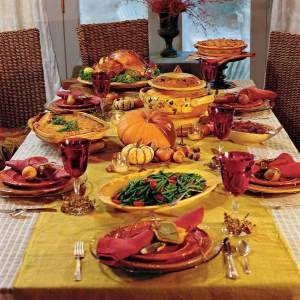
We focus on the joys of a full table and a full stomach.  thanksgiving-feast

We honor the achievements that come out of the kitchen and take note of the flavors.  Whether it is “just like moms” or “please pass the salt”, we think of this meal in reference to similar meals from other years.

We look at the good in our lives, if only for a moment, and honor it as a gift that it is given us.  We respond, as best we are able to, to those we are gathered with and to the Source of All Gifts, with gratitude.

We give thanks.

I worship in a faith tradition that regularly moves between seasons of feasting and fasting, of celebration and repentance.

I stink at fasting.  In recent attempts, I find myself a weak puddle of well-meaning intention and flabby will.

But, in many ways, I stink at feasting as well.  I get caught up in the tasks, the work, the needs and I don’t take time to bask in the joys, the smells, the moments of the feast.

There is a moment at the Thanksgiving table when silence passes over.  In that moment, I hope my heart is reminded to look at what is happening.  To look and to actually see the joys of the feast that is unfolding, to see the goodness at hand and honor it.

adventcand51

For by the time the Thanksgiving tupperware is being loaded into the dishwasher, the leftovers consumed over the course of days, attention shifts to the next great holiday on the horizon.   In just a few days, the deep-purple season of Advent arrives, a holy time which whispers:  “Slow down. Look deeper. The little one, the vulnerable one–He’s coming!  Create a bit of room!” These weeks of anticipation for Christmas, full of parties and shopping and yummy treats, are ironically, a time of fasting.

As faith is whispering a message of internal preparation, the world cranks the volume on its siren song:  “Buy me! Eat me! You are running out of time! Now, do it NOW!!!”  Frenzy and fuss, set to the tune of holiday jingles.

Perhaps if I can have a moment of attentiveness–of clear vision–during the Thanksgiving feast, I will be able to approach the Christmas preparations with new sight as well.  Perhaps, just perhaps, when He comes at Christmas, He will find my heart not stuffed to the gills with worries and outings and lists.

Rather, He will find just a bit of space that is hungry and longing.

Pizza on Thanksgiving

When I was 21, I was a college dropout living on the floor of a friend’s apartment. I was estranged from my family because I chose not to be around them, and I was completely lost in myself.

During that year, I spent nearly every day alone. Over the previous two years of my life, I had slowly slipped into myself, away from friends and any purpose to guide and drive me beyond the most present satisfactions.  I lived in a cage of self-absorption. For Thanksgiving in my 21st year, I missed all of my family’s activities, including our goose-hunting trip and the Thanksgiving Day meal at the ranch house. Instead, I chose to cut myself off from communicating with everyone, seeking desperately to avoid seeing another face that might recall me to my own lonely heart.

I have always been content alone. My mother often told me I was so easy as a child because I needed no attention—I had my own mind to get lost within—yet this also rightly worried her because I did not seek others out, especially when I was hurting or feeling shame. By the time I was 21, after two years of burying myself in the shame of not living up to who I could be as a student as well as a pile of addictions and self-hatred, I was even more intent on fleeing others; they awoke in me an awareness of just how lonely and lost I was. I could hide my heart’s aching loneliness from myself with a series of addictions and distractions, but the face of another person was a mirror to me.

Thanksgiving day for my family usually consists of turkey, stuffing, endless rolls, a goose, pecan pie, football, and thanksgiving. The central focus and culmination of our meal is our giving of thanks where, with a solemn yet joyful procession around the table, we offer up our gratitude for family, friends, and all the goodness of life. This is one of many sacraments my family practices around the dinner table on special occasions. For birthdays, my family intentionally sets aside a time at the end of the meal to tell the family member who was born that day why we love them. These moments recall us back to joy, thanksgiving, and shared love. But for that Thanksgiving, I was a prodigal so desperately mired in the muck of myself that I could not handle love, joy, and thanksgiving. When we turn in upon ourselves and seek our satisfaction from only what we desire, our hearts can shrivel up to the point where love and joy become painful for us. Right then, love and joy were painful for me to encounter.

Instead of community and celebration, I spent that Thanksgiving alone. I locked myself up in the apartment and wanted no one to come near me. Because I was so afraid of seeing another face, I did not leave my room until I became hungry. Around mid-afternoon, I finally decided to order pizza (which to my surprise was still delivered on Thanksgiving) and waited in my cavern for it to arrive. I was watching football, just like my family was likely doing, when the pizza arrived. When I opened the door, I found a young man, probably my own age, looking at me quizzically. I immediately wondered: Why was this young man working on Thanksgiving? What had led him to the point where he wasn’t at home with his family, eating a joyful Thanksgiving meal? Was he without a family or friends to share joy and love with today?

Then, I saw in his eyes the same questions being asked back at me. Beneath my armor of distractions, the desperate beating brokenness of my own heart pulsed with billowing pangs into my consciousness. In this pizza delivery boy’s face, I saw my own loneliness.

Driving through a small town on I-45 the other day, I saw a big billboard, the type of sign you only see in a small town in Texas, which read: “Lost? The map is in My Book. ~God”. When I saw it, I was struck by a realization: When I am lost, the map back to where I need to go has not often been written on a page but in the face of another person. When I was lost that Thanksgiving day, the face of a pizza delivery boy first woke me to how lost I really was. Now, every time I attempt to escape back into myself to hide from the constant reality that I am lonely, broken, and in need, I find myself face to face with another broken heart. I writhe to run, but the God whose face is always seeking mine will not let me turn forever from my own brokenness. I am recalled back to the place of my own poverty, where I am unable to live without another living within me, beside me, and for me, and where in turn I am called to live for others outside the ruinous cavern of myself.

Pho la la la la.

The restaurant was a twenty minute walk from his house, and walking was our favorite way to get there.

Outside, our laughter warmed us, even as our breath froze along the top edge of our scarves. We strode down the hill, the cold air burning our lungs. It felt invigorating, not punishing as it sometimes does, but still, it was a relief to step inside.

And inside, it is the steam I remember.

Steam, rising off the bowls that were recently boiling, filled the air, condensing on the cold window. Our coats hung on the rack behind him, and we were tucked in, surrounded by warmth. He leaned over the bowl, breathing in cardamom, cinnamon, star anise and ginger, and the steam clouded his glasses, making his eyes disappear. Now the sound of our laughter filled the small restaurant, entwined with steam and the sense of the glorious unknown.

Over a bowl of soup, I was falling in love.

****

I had not known this particular type of soup before I met this particular man, this one who would become my fiancee before the northern world warmed again. The soup was Pho, comfort food from the faraway land of Vietnam.

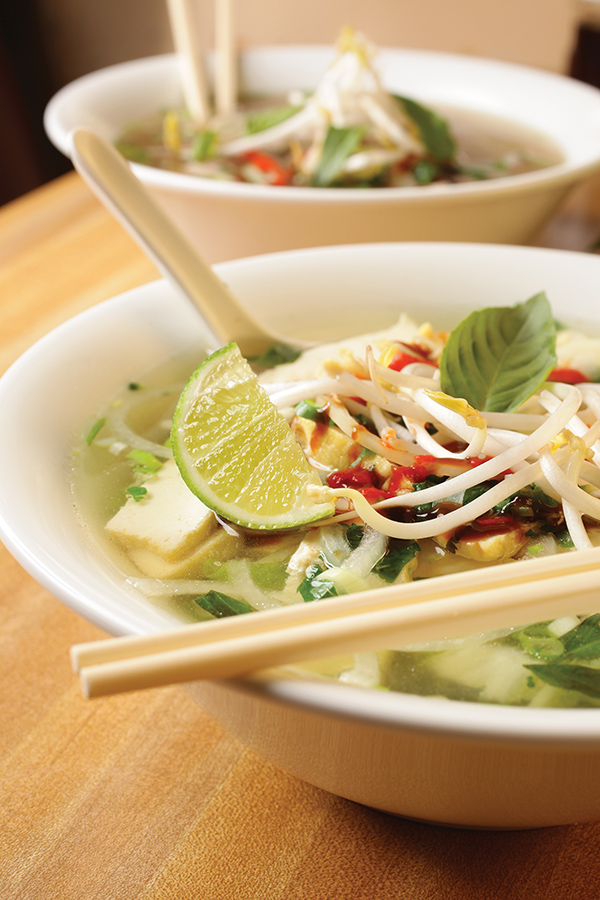
phominh

The base is simple: clear broth, beef or chicken, with onion and spices. Heated to boiling, the broth is combined with long white rice noodles and some kind of meat, and rushed from the kitchen to your table. Sometimes the meat is still pink when the soup arrives, but this is part of the fun. Just take a chopstick, push it into the broth and watch it brown.

With a bowl of Pho comes a plate of toppings: crunchy bean sprouts, leafy thai basil and limes, all piled high. What luxury in mid-January! And the final step makes each bowl your own creation. Sauce. Will it be sweet brown hoison, spicy sriracha, fish, or salty soy? Or if you’re really brave (or have a really bad cold), how about a dollop of that mysterious red paste?

Just go slow with the red paste. Trust me on this one.

****

We’ve been married for ten years, this man with the clouded glasses and I.

When we had been married for seven, our preschool daughter tumbled down the steps in our old Victorian house.  After a long and brave day in the Children’s ER, and ten stitches under her left eye, we asked, “What do you want to eat? Anywhere in the city. Anything you want.”

And she said “Pho.”

This fascinated me. How did these foreign flavors become my daughter’s comfort food? I didn’t know that Pho existed until I was almost thirty, and here she was, not even five, speaking Vietnamese. Of course we said yes, and soon we were bundled into the car for the short drive to our favorite restaurant.

The steam was the same as always, and so was the woman who waited on us. We had been bringing in our children since they were babies, and she knows them. “What happened to eye?” she asked in her staccato English. Our daughter gave her the play-by-play, and I provided the conclusion, “We told her she could pick any restaurant in the city, and she chose here!”

I waited, expecting surprise or even shock to cross our waitress’ face, but she shrugged as if this had been the obvious choice all along. “Of course you come here,” she told our daughter, “you need Pho to get better.”

“Now,” she turned to us, “Extra basil in the spring rolls? You want two or three bowls today?” She rattled off our normal order, we nodded, and she returned to the kitchen.

Settling into our chairs, we rested for the first time that long day. Of course we came here. Pho is our family’s ‘chicken noodle soup’, and though Vietnamese food may not be a part of our genetic code, it will always be a part of our story.

Lucia at Pho Minh


The first photo is from Pittsburgh Magazine, taken at “our” restaurant-Pho Minh. (http://www.pittsburghmagazine.com/Pittsburgh-Magazine/July-2010/Cheap-Eats/)

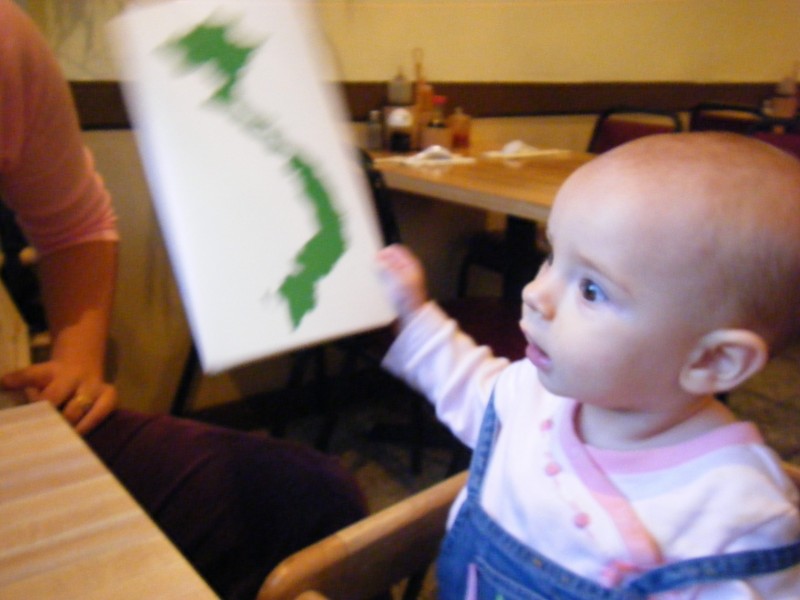
The second is of the aforementioned daughter, making her selection from the menu, three years pre-stitches.


Enough

I was a recent divorcee, and we were traveling to meet the family of the man with whom I was “the other woman.” Everyone had been gracious from afar, but I knew that his mom had been on the other side of infidelity and I worried that grace might be a little frosty in person. Perhaps there was forgiveness for the son, but not for the home wrecker girlfriend.

In the weeks leading up to Thanksgiving, I kept pestering Rich, asking what we could take to dinner. I was nervous about making a good impression. I knew that his mom was accomplished in the kitchen, while I was coming from a season of limited cooking. In my first marriage, I had all but given up preparing home-cooked meals, relying instead on prepackaged food to feed my family. With Rich’s encouragement, I was beginning to stretch my culinary wings a bit, but preparing anything for his mom, my eventual mother-in-law, felt like a test that I was destined to fail.

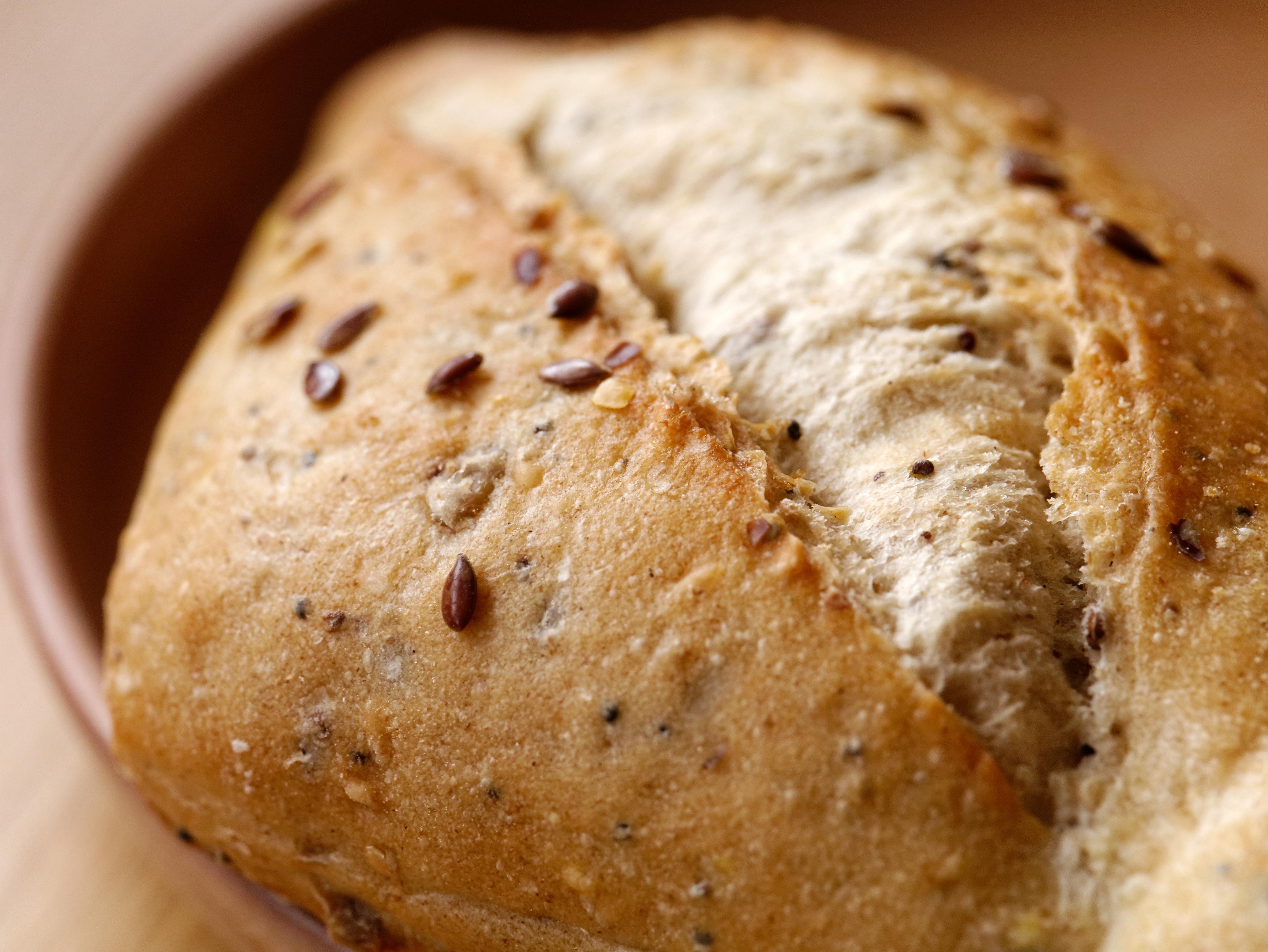
00781 (1)We finally decided that we would take bread and salad. We made two loaves of bread, made some compound butters, and bought the ingredients for a Caprese salad with a balsamic reduction. I knew it wasn’t enough. In light of a turkey and mashed potatoes and homemade cheesecake, what were a couple loaves of bread and some mozzarella, tomato, and basil leaves? It wouldn’t be enough.

I wouldn’t be enough.

The truth was, I wanted to take something that might cover my inadequacies as a cook, but also as a potential wife, as a mother. Something to prove that I was more than an adulteress. It was my first major holiday apart from my children, the first Thanksgiving in years that I wasn’t spending with my parents, and I longed to be accepted as a part of this family—to have a place in this home during a season when I felt displaced in so many areas.

As mealtime approached, my nerves increased. Rich’s brother and sister-in-law had welcomed me to their brand-new home warmly, even if the heater wasn’t working properly. But I was still waiting to meet the woman who had given birth to the man whose hand I was currently clutching. Our meager offerings to the Thanksgiving feast looked as small as I felt.

We heard the Jeep pull up the driveway and I could feel my heartbeat quicken. We should take the bread and go. Go before she had a chance to look at me and disapprove.

She came through the door, and her sons went to give her a hug. I stayed back to give them an opportunity to say hello, then she made her way over to me.

And she embraced me.

The rest of the day, we sat in the kitchen, cutting up potatoes together, tasting the balsamic reduction that Rich made, laughing, telling stories. I had a piece of her cheesecake, she had a piece of our bread.

Everything was delicious. Everything was enough.

 *  *  *  *  *

424033_10151308414006236_662319879_n (1)“Enough” was written by Alise Chaffins. Alise is a wife, a mother, an eater of soup, and a lover of Oxford commas. You can generally find her sitting behind a keyboard of some kind: playing or teaching the piano, writing at her laptop, or texting her friends a random movie quote. She lives in West Virginia and blogs at knittingsoul.com


Cut from the same dough

When I was growing up, they were simply “Christmas cookies” to me—not butter cookies or cutout cookies. Just Christmas cookies: the quintessential sweet of the season.

Of course, there were many cookie varieties on the platter my mom kept stocked on the kitchen counter throughout the holiday season. I had to taste each of the others at some point—the gingerbread, the mini pecan pie shells, the coconut and chocolate “magic bars,” and the shortbread squares with salty cashews pressed into the caramel on top. But when the platter was offered with the instruction to “just take one,” my small hands only hovered over other choices before inevitably gravitating back to a beloved “Christmas cookie.”

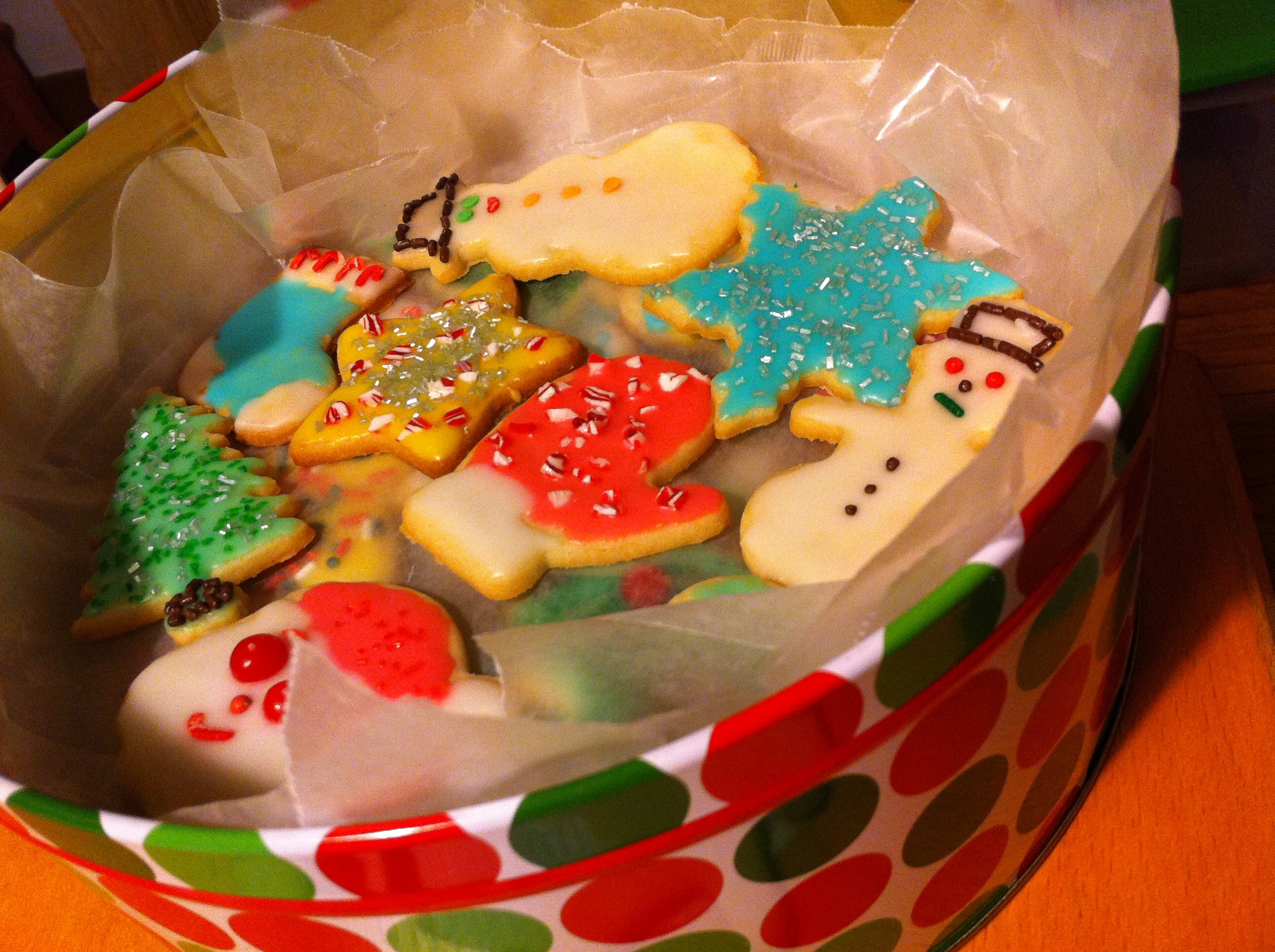
cookietinAs an adult, I consider these classics a family recipe, but in truth, the five-ingredient list is hardly complicated, or a secret: butter, flour, sugar, an egg, and—most importantly—a half-teaspoon of real almond extract (imitation is forbidden!). First, as with all cookies, the butter and sugar are creamed together before adding the egg and almond extract. Then the flour is carefully stirred in. For years I had to hand over the spoon to my mom when the last cup of flour went into the bowl, and for years I was in awe of how strong she was, as I watched her effortlessly finish the job my wimpy arm couldn’t handle.

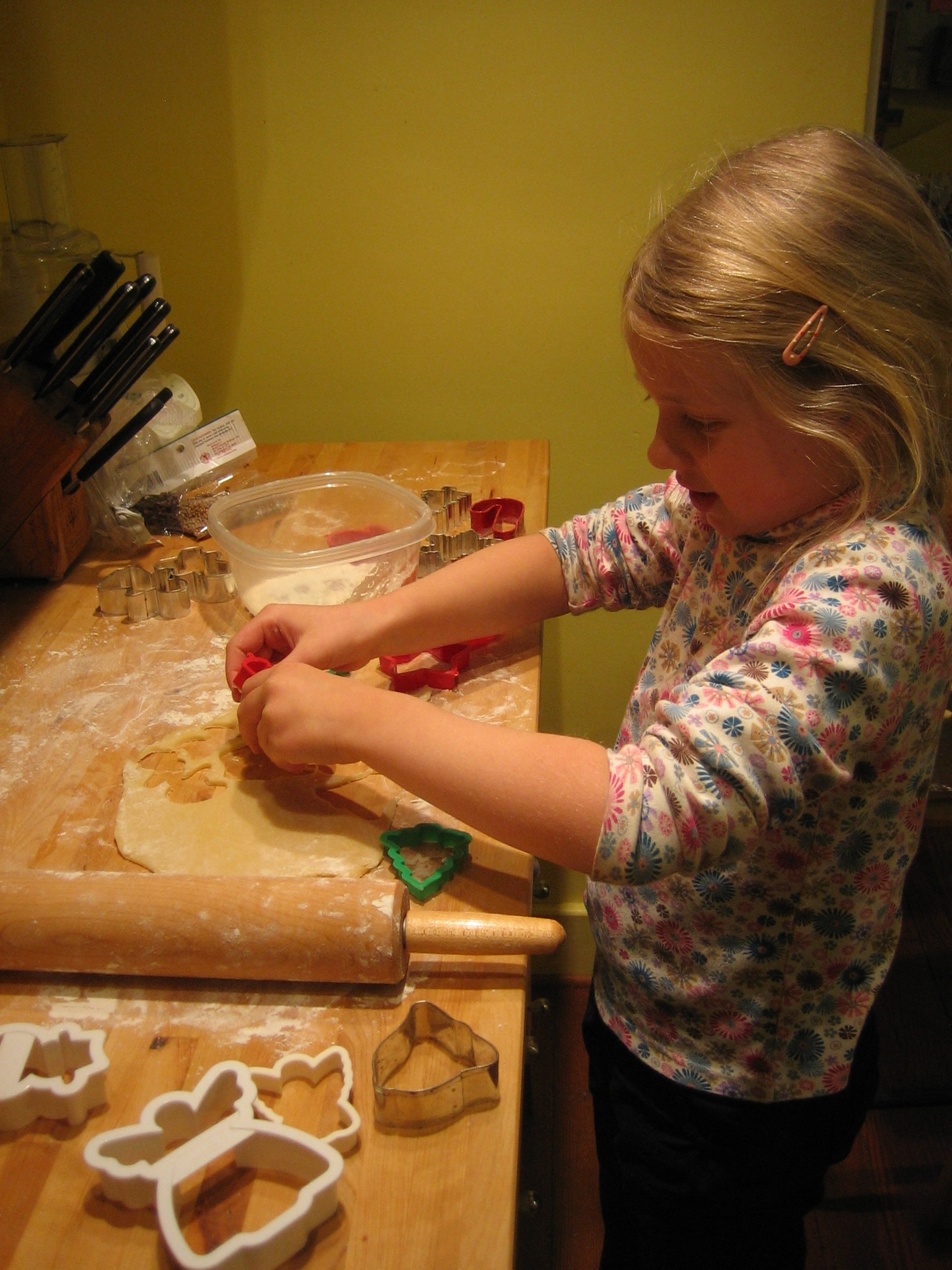
scookiecutterAfter the dough was chilled (a step I was never a fan of waiting through), my mom and I rolled it out to a careful ¼-inch thick round ready to be puzzled into Christmas shapes. It was with Christmas cookie dough that I learned to use a rolling pin: gently but firmly, keeping the pressure even between left and right hands, learning to lift the rolling pin slightly as it reached the outer perimeter of the dough, so as not to leave the edges too thin to be cut.

Opening up the tin of cookie cutters each December was as thrilling to me as unearthing my family’s boxes of tree decorations. All the old favorite shapes were there—stocking, tree, candy cane, wreath, star, santa, and the gingerbread boy and girl (which we didn’t hesitate to use on non-gingerbread dough)—as well as the surprise of a new cookie cutter or two we had added to the collection the year before. I learned to be strategic about arranging each shape before pressing it into the dough, minimizing the scraps of dough to be gathered and rolled out again. The outstretched leg of the reindeer nicely made use of a little strip of available dough left along the top of a tree’s point, and the positive points of one star could utilize the negative spaces left by another star.

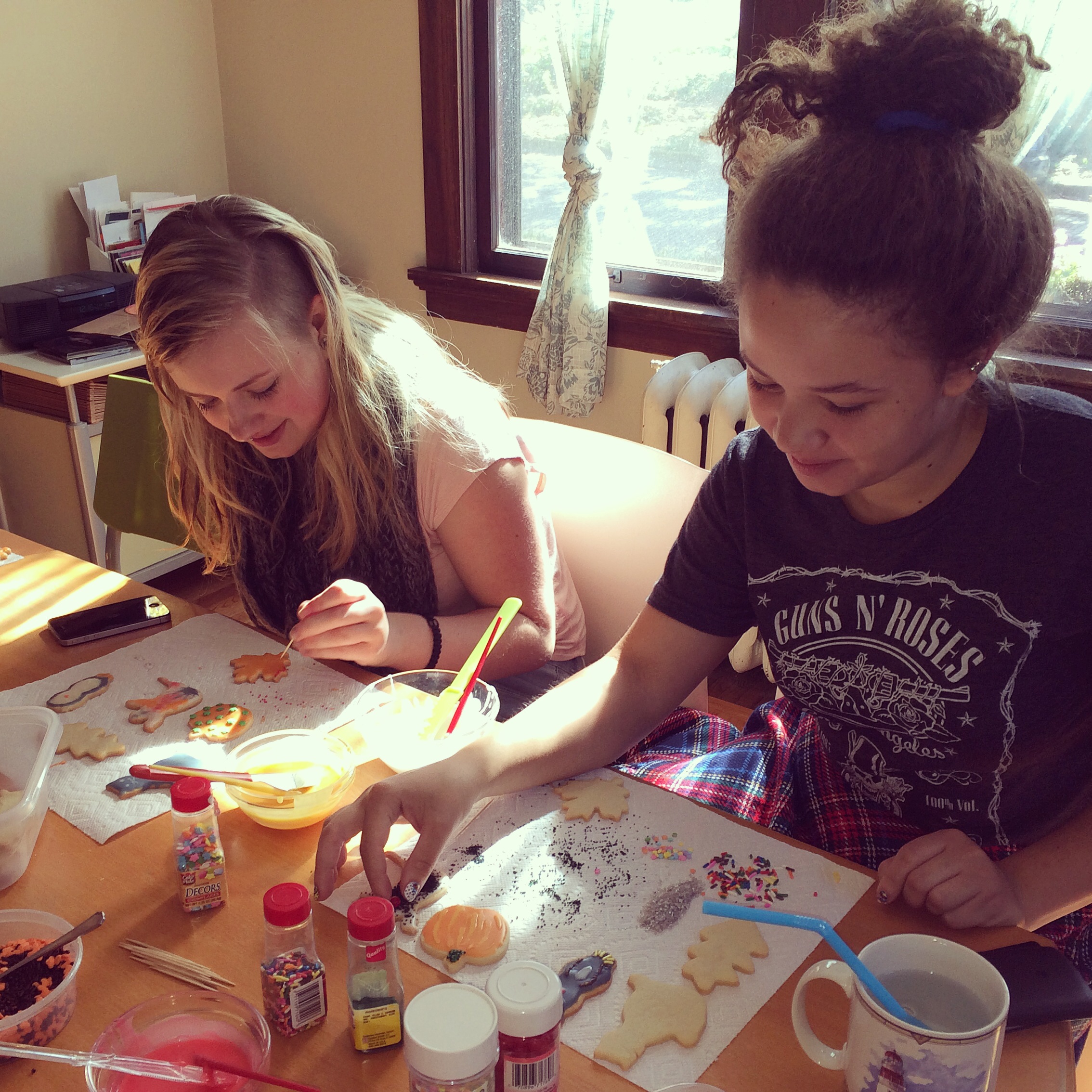
Frosting and decorating the cookies, though, was the best part of the process. The bowls of colored frosting and various sprinkles were laid out on the table, drawing the whole family as if they were a feast rather than work to be shared. Over the years, our approach became increasingly elaborate and creative. Armed with toothpicks, we discovered techniques for swirling two or more colors of frosting in the middle of a star, and for picking up and placing tiny candy balls exactly where we wanted them, along the hem of an angel’s dress. In his teens, my brother went rogue with his approach, transforming traditional shapes into entirely different objects—an upside-down stocking became a hobby-horse, and bell became a space shuttle, with USA spelled out carefully using those small, stick-shaped chocolate sprinkles.

As a college student, making and decorating “Christmas cookies” was always my first order of business upon arriving home after finals. Years later, after having my own children, I could hardly wait for them to be old enough to sit around the kitchen table and decorate cookies with Grandma and Grandpa and Uncle Bill. When I eventually met Jason, I knew immediately he and his daughter would embrace the slightly-competitive fun of our family’s cookie decorating marathons. (A man who would scoff at such an activity would be no man for me!)

Our three daughters are now teenagers, and the “Christmas cookie” tradition continues—even beyond Christmas. Somewhere along the line, it occurred to me that “Christmas cookies” could be made at other times of the year, so I began buying new cookie cutters: tulips and rabbits, pumpkins and maple leaves, hearts and snowflakes.

photo (2)A few weeks ago, on a cold Saturday morning, we sat down around the dinning room table, where stacks of naked autumn cookies waited for their sweet, creative disguises. Each of the girls had invited a friend to join us. “I didn’t realize other people even did this any more,” one of our guests said, picking up a toothpick and getting intricate with her design.

The cookies are definitely special—everyone who sees them and bites into one agrees. But for me, it’s the tradition of time spent together—evolving as our family evolves, yet remaining the same from year to year, in a life where it seems nothing really remains the same—that I crave most this time of year.

Monogram

Fifteen years ago, I remember my mother-in-law, a lady from the Eastern Shore of Virginia, saying to my husband Tom and me: “I want to start giving you the family things so you can enjoy them, and the children can grow up with them.”

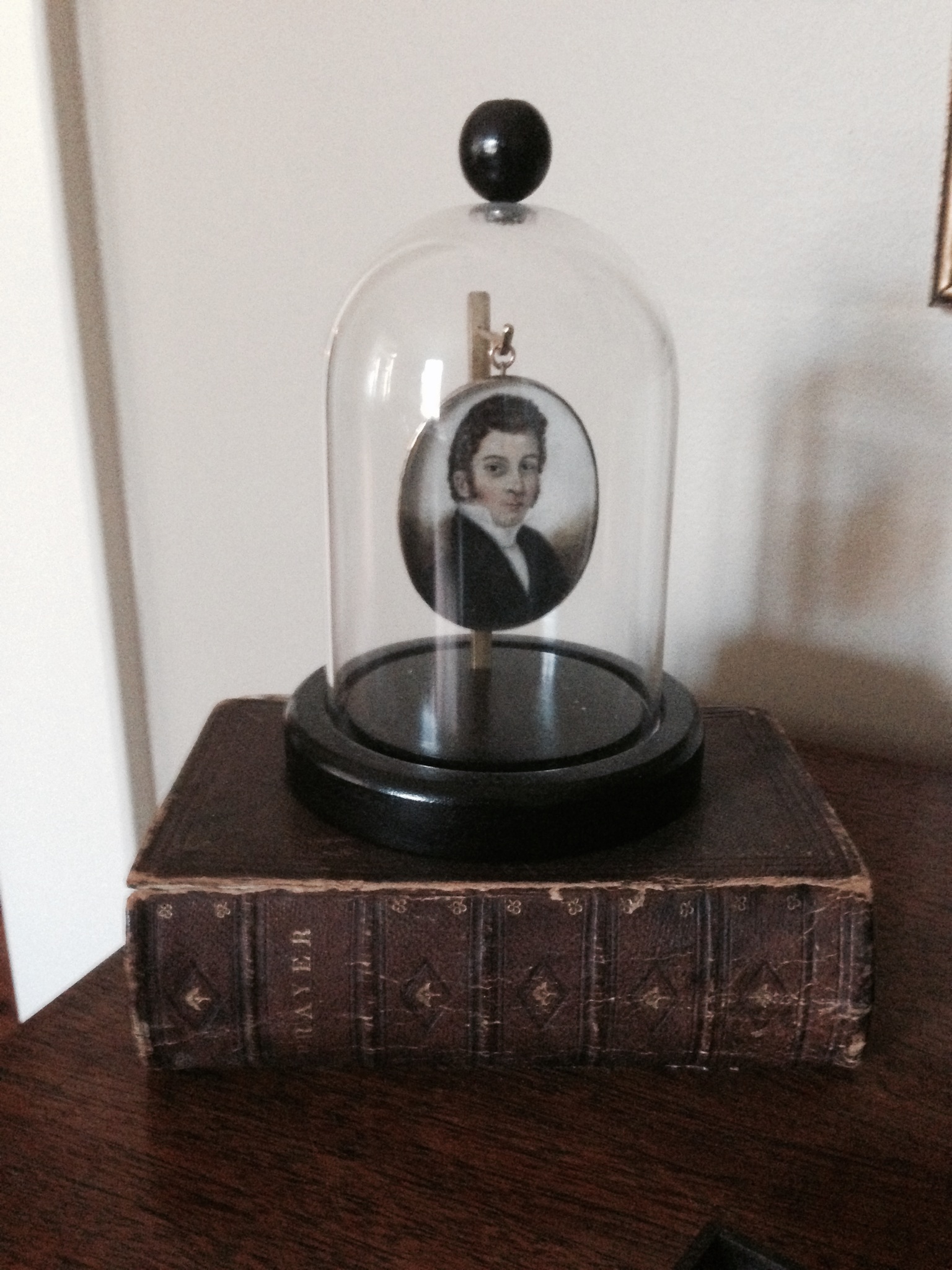
Since the time she entrusted us with the family heirlooms, I have endeavored to give them meticulous care without creating a museum-like atmosphere in our home. Our children have learned to appreciate their heritage because of the stories told by their grandmother, ones in which they are related to the settlers of Jamestown, U.S. Presidents, scalawags, crazy aunts, and sturdy women who saved the family furniture during hard times. The silver, china, books, and furniture handed down to us are not “just things,” but they reflect the lives of those whose faces speak from their portraits on our walls.

*****

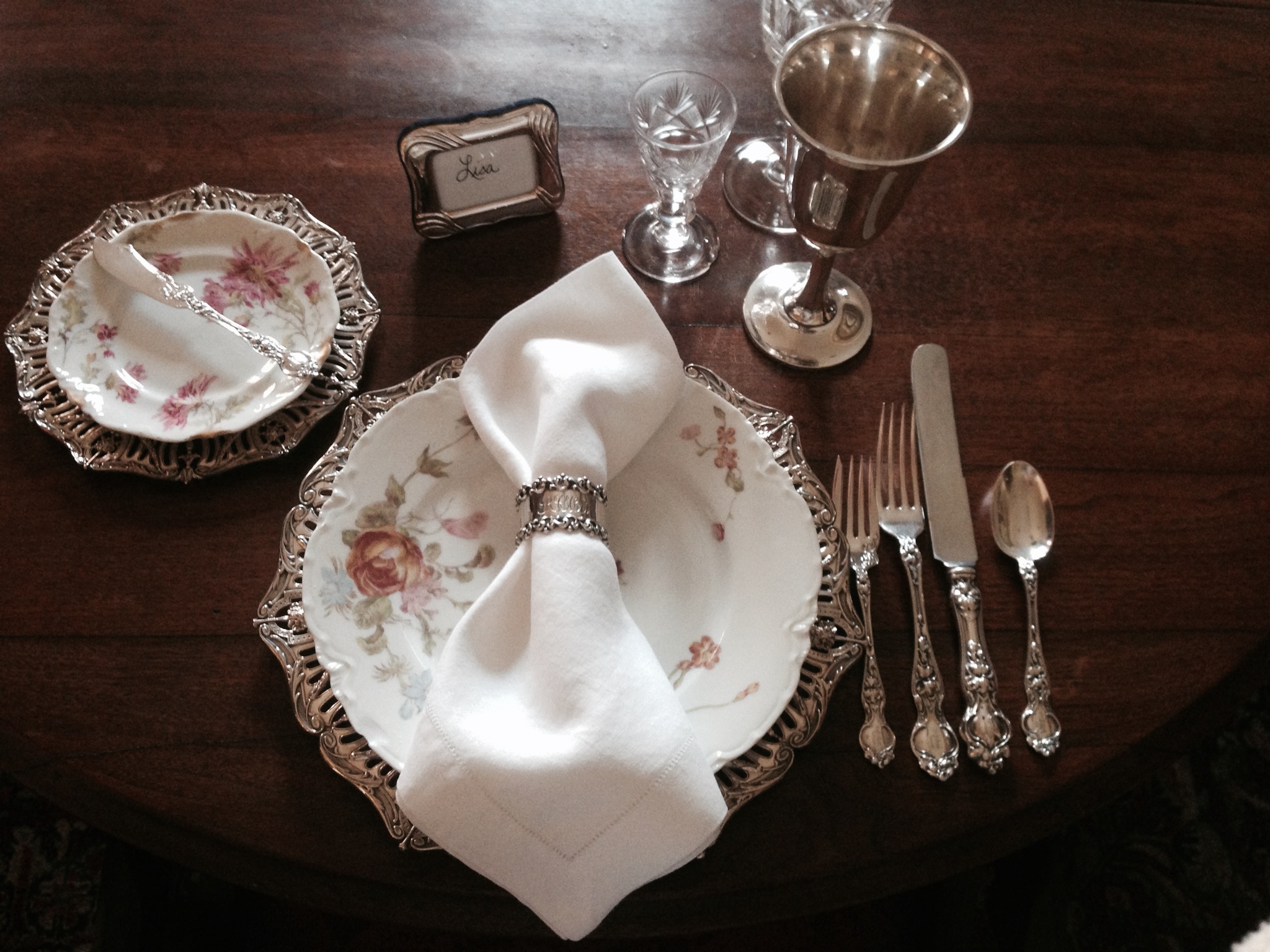
My favorite part of preparing for Thanksgiving is when I hide in the silver closet like a Confederate hiding from the Yankees. I pull out silver place-settings, serving pieces, bowls, trays, goblets, and napkin rings. The late nineteenth century Haviland Limoges china, delicate, but durable, is arranged in my china cabinet. I hold my breath and move in slow motion as I retrieve dinner plates, bread plates, butter pats, serving bowls, and meat platters from the shelves.

Everything is carried to the dining room, and I begin to dress the table based on the number of guests I will feed, and the dishes I will serve. I think to myself: Will I use napkin rings or tuck the napkins under the plates? Tablecloth or place-mats? Iced teaspoons?

I fuss over the details of creating an inviting table, not one that is high-brow, (dinner attire is flannel and denim), but a table-scape of respect and gratitude for the women of past generations who set this family table for Thanksgiving.

photo(32)A cooking marathon begins in my kitchen on Thanksgiving morning and by dusk, the turkey is resting plump and tender on the Haviland platter. It is time to dim the lamps, light the candles, and call our dear ones to the table. Tom usually interrupts the loud, pre-dinner banter, but sometimes our son will play the antique tabletop chimes to announce that dinner is served. A blessing of praise and gratitude is prayed. When the eating begins, the room grows quiet except for the “mmms” heard as we taste the richness of the food. Hearty appetites satisfied give way to hearty laughter, and everyone pushes back from the table and begs off dessert until later.

I am weary, but satisfied, content to linger at the table. I think about the father-in-law I never knew who, forty years ago, sat at the head of this  table and buttered his bread and stirred his iced tea with the silverware that bears his monogram. My husband and children have the same monogram engraved into their DNA, and with His gracious pen, God has written me into the same story.

photo(33)

Wilderness and the Costcolypse

What do we talk about when we talk about food? It’s my feeling that discussions about food always reveal at some level the most intimate, spiritual, and dearly held values with which we compose a life. I think, for instance, of the struggle that some families I encounter go through to make ends meet, and how many times we frame this basic challenge in terms like “putting food on the table,” or “keeping the kids fed.”

It’s hard for me to contemplate my relationship to food in Alaska nowadays without my thoughts swiftly veering to Don Rearden’s wonderfully eerie, post-apocalyptic novel, The Raven’s Gift. The book, which came out in 2011, takes place in an Alaska that could easily and believably prove five minutes or five or fifty years into the future. Set around the far-flung region of Bethel – a city (population approx. 6000) accessible only by air or river in Western Alaska – we encounter John Morgan, a man who with a large heart and pure intentions moved to the remote location with his wife, Anna. Both aspired, in overly relatable, starry-eyed ways, to experience first hand one of the lone, final wilderness frontiers on Earth. John and Anna find their way North and court adventure not by aiding to plunder the state’s wealth of natural resources, but by following opportunities to live and teach in the schools of a community comprised primarily of Native Americans.

The Raven's Gift, Don Rearden

But then things go horribly awry, descend – as the book’s jacket reads – “into total chaos.”

Rearden never goes far out of his way to specifically detail what happens that sends John’s life careening into the most unintended, terrifying and primitive form of survival imaginable. It’s not the “how” we got here that matters. It’s purely, “You’re here. Now what?” We hear rumor of a deadly epidemic. Did it spread through all of Alaska? Did it reach beyond Alaska and infect America? Or was it restricted only to Bethel? Was it an intentional epidemic? But does it even matter? When an unexpected stranger offers Morgan a cup of broth – after wandering how long without food in his belly – you don’t care about the origins of this tragedy. You’re sipping broth with him. When he risks a daydream about a cup of coffee, you’re shivering in your bones, too, and you want to offer him a simple cup of joe. The novel puts a man with minimal skills in the absolute barest of imaginable circumstances, strips him of everything he possesses and loves, and tells him only, “Survive this.”

The story offers a unique perspective – with a touch of Stephen King, and periodic nods towards The Road – regarding the curious dilemma that comes with trying to live out one’s dreams up here. Intentionally or no, it indirectly asks readers how they would survive in one of the rumored remaining “wild places” in the 21st century as it strives to become as domesticated and predictable as every strip-malled and fast-fooded location that many of us came here to escape. On one hand, in Alaska, we can hunt wild game and catch and wrestle with so many salmon in the summer that they will swim through your dreams. We can pick our weight in wild blueberries for free, and not pay the exorbitant prices for farmed blues that our friends and family pay Outside. (“Outside” is ow we refer to everywhere in the Lower 48.) And yet, despite this, it often strikes me that a low-level anxiety persists.

It’s noticeable when you hit Costco or Sam’s Club on the weekends. It’s in the way the crowds, myself included, flock in droves to the warehouse stores to purchase mountains of foods and goods that come shipped to us from Anywhere out of state. You can ask me about terrifying bear encounters all you want, but in Anchorage I’m more often worried about escaping the Costco parking lot in one piece than I am concerned with encountering wild animals on a hike in the woods.

Costco

The idea that “Alaska” largely proves synonymous with “survival(ist)” probably isn’t news to anyone. And, to the credit of more than a handful of true-to-life rugged individualists past and present, the state definitely boasts a fascinating library of stories revealing that many Alaskans live life a little closer to the bone than the majority of their fellow Americans. And while there’s not time or space to explore the topic here, we’ve also seen a rapidly growing demand for locally grown produce and goods, and are watching farmers markets gain traction at the local level in ways they wouldn’t have a decade ago.

But Don Rearden’s novel turns a blind eye to our romance with “Alaska” and challenges every naïve notion we carry about “wilderness.” And he does it in such a way that I consider his post-Apocalyptic Alaska tundra every time I walk into Costco and see crowds manically surviving, depending on mountainous flats of pre-packaged foodstuff and goods that rely on barges, flights, and massive amounts of fuel in order for us to consume it. I see John Morgan staggering across the naked tundra when I hear my coworkers or students giddily rave about the new Olive Garden or Chile’s coming to town as if we were a remote African village miraculously acquiring a fresh water resource. What is this nimble, unsustainable set design we’re blissfully constructing in Anchorage, and what does it say that while we’re welcoming it here, many communities Outside are beginning to reconsider and address the glaring errors and dangers that exist in this format?

The winter I first read The Raven’s Gift happened to be the snowiest winter on record in southern Alaska in nearly 60 years. This, compounded with the fact that I had become a single father only a couple months prior to that cold, record-breaking season caused the book to leave an indelible mark on my trembling, unnerved heart.

Sprawled along my couch those dark, lonesome and silent evenings, I would set the novel down and look past the frosted windows of my apartment, stare out at the four-foot high mounds of snow in the front yard and find in John Morgan’s plight a frightening metaphor for the stark terrain of my new life in Alaska. It was impossible not to feel stranded and terrified in those months, living as far away as I do from my entire extended family and closest friends, all while striving to make ends meet each week, to survive on a very middling-, single-income from my work at a non-profit social service agency. Never mind wanting to be “a good father” (or husband). What did/do those terms even mean? All I knew to want then was whatever would keep the boys healthy and fed.

Snow-moose

What do we talk about when we talk about food? I believe discussions about food are at heart holding and asking the most valuable questions about our collective survival, on one hand, and that discussions about survival explore and reveal our most deeply cherished values and intimate connections to the places we find ourselves and to all the people we encounter there.

John Morgan encounters these truths in the most primitive way imaginable. I’ve been fortunate enough not to learn these lessons as brutally as he does, although his journey strikes me as eerily familiar, and never very far away from my own.

winter2012-01

Coming Home: A Christmas Culinary Experience in Texas

When I list my favorite things about Texas, I always start with foods and drinks: Blue Bell Ice Cream, Tex-Mex, Kolaches, Dr. Pepper, and Shiner Bock. Texas has the great distinction of being home to many very distinct and delicious culinary cultures. The obvious ones, Mexican food and Texas BBQ, produce the glory known as brisket tacos. But the lesser known distinct cultures are those from Germany and Eastern Europe. Texas once was the destination for many immigrants from Germany and Czechoslovakia, and in the broad scape of Texas, these immigrants settled in very distinct and geographically separate communities (some so isolated they still speak their native languages) bringing with them their culinary gifts. The Germans brewed their beer creating for Texans the amber-brown delight of Shiner Bock, which is brewed in the small German community of Shiner, Texas, and the Czech’s baked their bread and made their sausages and gave us the kolache (I’m constantly stunned by the number of people who have never heard of nor tried a jalapeno and cheese kolache).

For my family, Christmas meals are a wonderful sampling of Texas’ diverse delights. My family starts on Christmas Eve by treating ourselves to the best tamales I have ever had, made in a little East Dallas shop, as well as a sundry of other delightful Tex-Mex dishes, all served buffet-style in the comfort of our home with some extended family joining us. I am generally so utterly stuffed by the time the meal is over I can barely stay awake through our annual watching of “It’s a Wonderful Life.” The next morning, Christmas opens with kolaches and cinnamon rolls, but I must pace myself—the true joy of Christmas is our late lunch at my aunt and uncle’s house.

Every year my family spends Christmas afternoon at the Kolenovsky’s house. My uncle is of Czech descent, and he and my aunt make an excellent culinary combo. They put on a feast of feasts, spending weeks gathering recipes and preparing for the Christmas celebration. The group is not large, but we quite literally feel like attendees to a king’s feast as the food is examined and the paper crowns and poppers are arranged upon the table. The dishes are an array of Czech soups, smoked ribs and meats so tender they melt in your mouth, unbelievable dressings and stuffings ranging from classic breaded ones to raspberry jalapeno sauces, vegetarian dishes for my sister and father, rolls upon rolls with the prescience to know that I will eat four (well earning my “muffin man” moniker given to me by my aunt), and another Texas staple: pecan pie and ice cream for dessert. They also choose delightful wines and drinks to go with the meal, and never forget to allow for my family’s addiction to Dr. Pepper. All of the tastes overwhelm me—even the thought of the meal will leave my mouth watering.

At the end of every feast, we generally find ourselves in a dazed comatose as my aunt and uncle read us something full of wit and heart. Sometimes these readings make our bellies roll in laughter and sometimes they make us weep, like the time my uncle read us Rudyard Kipling’s poem about a dog dying just two months after we had lost our dog. These moments are as close as I have been to truly coming home. We spend decades of our lives looking for a place we know with our hearts is home, and on Christmas day, the day marking earth and heaven being brought together for all eternity, my family gathers around for a feast, draws near to our true home in this communion, and eats from the best dishes the land God blessed with His own hand can offer.