On mornings, intention, and getting still enough

I’m no purist. As soon as the temperature dips below 90—usually mid-October in this part of Texas—I start pouring eggnog into my coffee. This may be one of few truly habitual morning routines I have. By design, I resist routine in the mornings. I have never been the sort of person that wakes the same time, has the same breakfast, has the same commute. I don’t find this to be noble. I have tried with limited success to become that sort of disciplined person, anchored in morning ritual and liturgy of coffee cup and toast point and made bed. I manage for a few days, at most, and then the resolve slips away from me and I’m back to a disordered sense of morning duty, careening from grocer to writing to recycle bin to conference call.

But eggnog in the coffee cup, that point in October when it becomes justified, slows me down just enough. I catch myself getting still, hearing my breath, the way the brick of the apartment whistles when wind cuts across it, the feel of the cement beneath bare feet. I sit across from the windows that keep watch with the sunrise and pull out the notebook, forgotten too often during the late season of summer, where pen is set to craft recipe, reason out flavor, and I plan a menu for the week. I get still enough to be mindful, yet again, of Alexander Schmemann’s speculation that no matter how utilitarian we have managed to make everything else, food remains something sacred to us, something that cannot be pure utility. There is reverence in the wielded knife and the butchered lamb, a kind of sacrament of patience in the warm of the midday loaf set on the windowsill to rise.

unnamedEggnog in the coffee cup returns me to this practice of noticing, attending to the detailed work of craft. I am no hater of technology, no scorner of social media, but in the brevity of the early morning pause, the breviary of an ordinary life, I disconnect just long enough to be mindful. Mindfulness is an underrated virtue. It doesn’t boast a great deal of acclaim. But mindfulness keeps us observant of ourselves and of the spaces we inhabit, keeps us intentional and keeps us kind. When I pause long enough to be careful, I am reminded of the miracle that it is to live, to taste, to smell, to make. We are alchemists of invitation and acceptance in our kitchens. We present common sacrament upon our tables. We offer chairs as signs of worth. We prepare tables as icons of welcome.

All this from eggnog in the coffee cup. Just enough of a pause in the waking hour, when the sun first colors the skyline, to remember the good work of being present, being focused, being exactly where I am. This is a ritual I can return to, when all else about routine fails. Clasped coffee cup tinged with sweetness, this takes me back to the center, to the contentment of the very moment.

*   *   *   *   *

Yancey.Headshot-5“On mornings, intention, and getting still enough” was written by Preston Yancey. Preston is an Anglican priest-in-training, an author, sometimes-painter, sometimes-baker, sometimes-scholar interested in Christian theology and the arts. He wrote Tables in the Wilderness, a book about God and silence, and lives with his wife, Hilary, in Waco, Texas.

Little Ears

“You’ll make a mess. Go outside to do that.”

With a prodding chide, my mom sent me to the front porch.

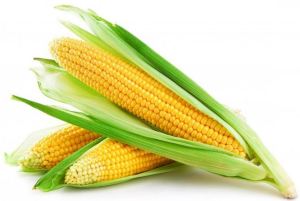
With just a bit of necessary force, my small hands grasped and pulled on the husks, exposing the yellow corn-on-cobkennels and sending silk wisping into the air. The husks ended up in the compost pile and the ears ended up in a pot of boiling water.

Sitting in our appointed spots, the tip of my pointing finger followed the rectangular pattern of the wooden table, hand-pieced together by my grandfather during a furniture making phase, as the meal was placed into the center of the table.

We bowed our heads as my father delivered a no-fuss blessing and then, passed the chipped serving dishes from person to person. A family favorite, each person took at least one ear of corn and smothered it in butter.  My dad peppered his; my mom added a dash of salt.  Silky wisps and a corn-shaped indentation remained in the yellow butter as it made its way around the table. As we began to eat, my little ears listened to the banter of my parents competitive jibes.

Pointing at the batch of undeveloped kennels, my dad teased my mom, “You must have grown this one.

My mom, delighting in her bite, “Oh, whoa….sweet and tender! This one must be mine.”

A celebrated feat, my dad would show off his empty cob, stripped perfectly clean by his two-handed, organized approach.  For us kids, our corn was wielded in one messy hand, kernels dangling from misshapen batches of half-eaten ears and off of our chins. But, with the growing stack of passed-over cobs, the remarks continued to fly.

Oh, this one is perfect. Definitely mine.”

It’s on the little side…must’ve have been yours.

In reality, they had grown them together. My dad guided the rototiller over the patch of land and planted the seeds. My mom weeded and watched for the infestation of bugs. Both took turns watering the rows of growing stalks and both prodded us children outside to participate in tasks of the garden.

Because it is was so evident that there was no “yours” and “mine”, these pokes and jabs were indications of affection, a life intertwined with a small patch of earth upon which they raised little ears.

1930948_32087567942_1403_n

One Fine Feathered Day

In May 2012 I pulled up behind a truck, parked just two neighborhoods from my own. The seller and I had been texting to arrange the exchange: “I’ve got your pullets.” “Great. Be there in 10.” “Just look for a white truck. Remember to bring cash.”

It was all over quickly, and I was on my way, a cardboard box on the passenger seat, grinning madly at the scratching noises and small bock-caws coming from inside it. I called my husband, “I’ve got them! Tell everyone the six of us are on our way!”

It was an exclamation point kind of morning. It was the morning we brought our chickens home.

****

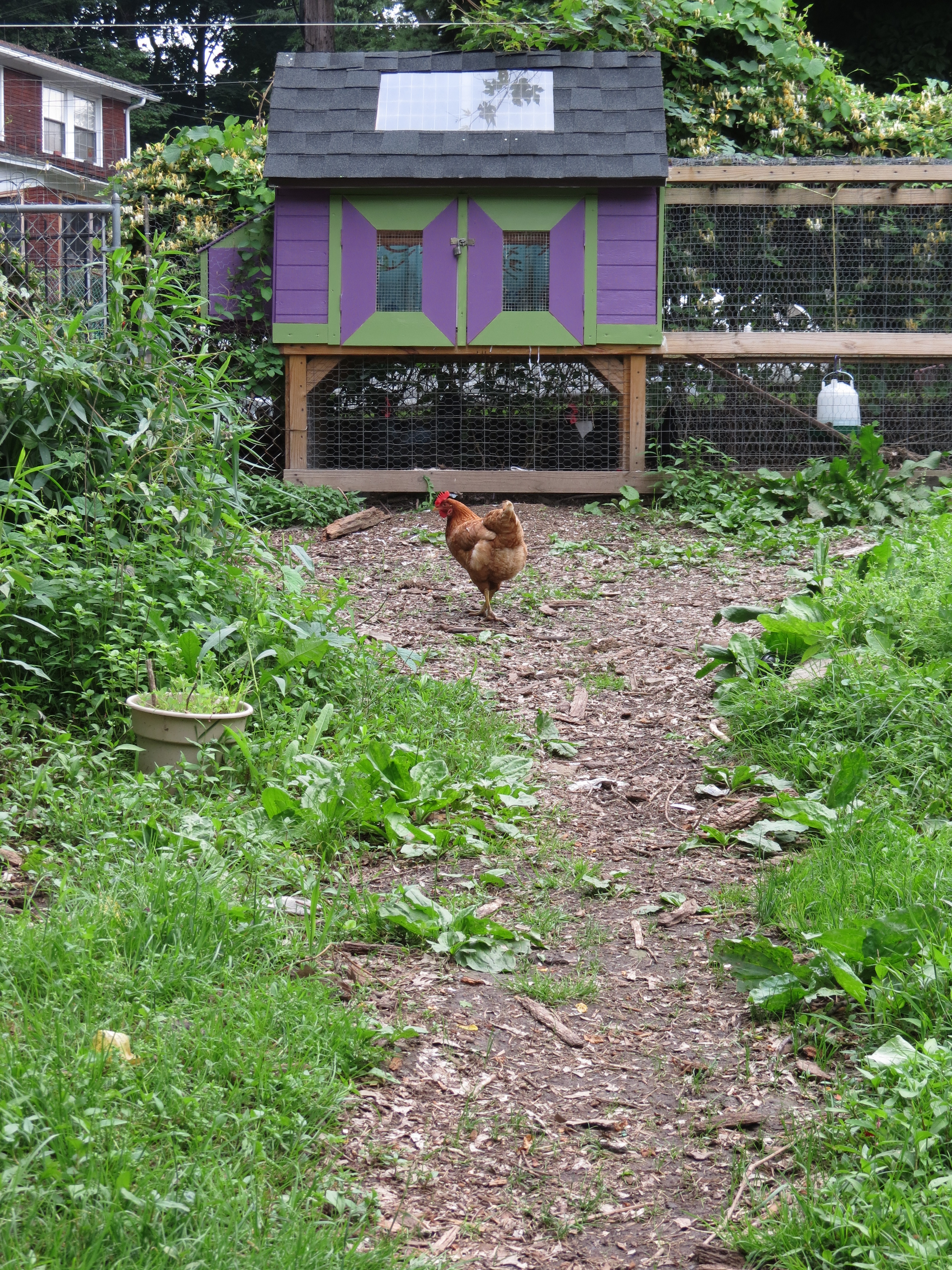
We had been preparing for months for their arrival. We attended an information session at the library, searched the chicken internet universe for tips, and dog-eared a book called “City Chicks.”  Along the way, we built the coop.

010

(Note the skylight. These are some spoiled hens.)

We researched nutrition, planned for pest control, and amused the well-worn country folk at Tractor Supply every time we went north to visit my parents. What are your organic options? Do you sell food-grade diatomaceous earth?  What about treats? Is this waterer BPA-free?

Okay, we really didn’t ask the last one. They were still recovering from our discussion of non-GMO based layer feed.

Now. Why did we do all this? Well, originally we thought that keeping hens would save us money, but this hasn’t been the case. On one hand you’ve got housing, food and chicken accessories (waterer, heat lamp, etc.). On the other, you have… not nearly as many eggs as you would expect.

Here is the deal with chickens and eggs: First, they have to be old enough to lay. Second, they can’t be broody, molting or recovering from a traumatic predator attack (a story for another post). Third, it can’t be winter. Fourth, you have to be able to find the eggs…

Question: Why did the chicken cross the road?

008

 Answer: To hide her eggs in the abandoned lot on the other side.

Let’s just say that the financial incentives aren’t overwhelming, but the daily Easter Egg hunts are a lot of fun.

****

So, why chickens? My answer is more of a hunch than a full-blown philosophy, but I suspect we keep chickens (and keep cleaning out their coop) because we love the sense of connection they give us.

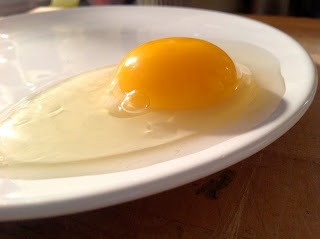
An egg in a styrofoam carton is just an egg, but an egg that appears after “Queenie” struts out of the coop and announces her accomplishment to the neighborhood (bock, bock, bock, baCAW!) is something more. “It’s still warm, Mom,” my daughter informs me, “and guess what, it came out of the chicken’s butt!” “Eww!” the rest of the kids collapse into giggles, and then start chanting, “chickens butt, chickens butt, chickens butt!”

Maybe it’s just a bit disgusting, but I like it that my children know–and by ‘know’ I mean through immediate experience–that eggs come from chickens’ butts. Not from egg factories, not from sanitary supermarkets, but from animals that poop, crow, and cross the road. Eggs come, and thus breakfast comes, from animals who are part of our daily lives.

This is why we will keep keeping chickens–not because it is terribly practical, at least in the way we do it–but because they remind us that food exists in a web of connections beyond buying and selling. Eggs exist because chickens exist, and our particular chickens exist because we fill their feeder and lock up the coop at night.

I’m glad we do. The eggs are amazing.

egg

(photo by Emily Duff, http://family2table.blogspot.com/2013/02/chicken-or-egg.html)

The Price of Avocados

It is large and green and looks so inviting. I imagine it mashed in a bowl with a jalapeño, a hint of tomato, some spices. But I can’t do it. I can’t spend $2.99 for an avocado, not even an organic one. I walk out of the store with my bag of kale and wine, avocado still on the grocery list in my mind.

One birthday, when I was in my teens, I asked my aunt to send me some avocados from her tree in Southern California, where I spent my first seven years. The box winged it’s way through two states and arrived at my Washington State door in February. Her avocados were different than the ones I could buy at the store, they weren’t as bumpy, or as small. All too soon, they were gone.

At least once a week, when I was growing up, we had tacos. My mom would pour a generous helping of oil into a skillet and fry our tortillas until they were crispy. Sometimes, we would fill them with equally crispy fish, cut into small pieces, coated in flour and sizzled in a neighboring pan. Other days, she would brown ground beef or turkey while I grated cheese and sometimes tore lettuce.

We would put all of the ingredients into the sections of a plastic tray. It was our taco tray, and I never thought to question whether it could have another purpose. Each member of my family would pile their shell high with the filling of their choice. I always made sure to add a generous dollop, or two, of guacamole.

When we had guests for dinner, after we moved to Washington, there was often a conversation about the way we served our tacos. In the Pacific Northwest, I learned, most people purchase pre-formed “taco shells” which seemed much more like large, curved tortilla chips to me. For the very brave, tacos were made with cold, soft tortillas. I was a polite child, and I ate these foreign foods without complaint when at friend’s houses, invited to stay for dinner.

When I went away to college in central Indiana, I was thrilled to be paired with a roommate from Texas. She will understand, I thought. We will pursue authentic Mexican food together.

Her uncle, a professor at our university, invited us for lunch some Sundays. On one such occasion, my roommate made guacamole. I watched, with mounting horror, as she added spoonfuls of Miracle Whip and stirred it in.

We were saying the same words, but we did not mean the same thing. It has taken me a long time to try Tex-Mex again.

On my visits to San Diego, my birthplace, I often see avocado trees from the window of our rental car. These trips are filled with family, driving, and the beach. Still, no matter how long I’m there, I always venture to Old Town, to a little place we used to go when I was small. I pause to watch the women in the window, making tortillas by hand as fast as they can. The perfect distraction, while waiting to be seated at the busy part of the day.

When my brother and I were little, my parents would order two Tostada Supremas and fresh flour tortillas. We would all make tacos out of these plates, which seemed monstrously big to my little eyes.

Now, when I go, I order a Tostada Suprema all my own, with extra guacamole, and a margarita. Somehow, I usually manage to finish the plate (though I have carried leftovers with me on the plane, inspiring jealousy in my fellow passengers).

Periodically, I buy some oil, tortillas and ground beef. I’ve been waiting for the price of avocados to go down, but they never seem to fall very far. I compare the small green fruit to a coffee, measuring it against any other indulgence, and it usually makes it’s way into my basket.

3665955683_a630020fcf_zI fold a paper towel and put it on a plate, ready to catch the excess oil from the golden brown tortilla, waiting to be filled.

I cut the avocado in half and draw parallel lines with my paring knife, just as my mother used to, scooping the resulting little squares into a bowl with a spoon. Always, I sigh with relief when the inside is green and a little firm. There is nothing like the disappointment of an avocado too ripe to eat.

I don’t belong in the land of my birth any more than I belong in the mountains and valleys of the Northwest. My roots don’t lead to any one place of belonging, but to many. Still, when I take a bite and close my eyes, I taste the peace of that which is familiar and much-loved, and I’m glad that I splurged on the avocado after all.

*   *   *   *   *

cara profile“The Price of Avocados” was written by Cara Strickland. Cara has lived in San Diego, California, London, England, and Upland, Indiana. Once, in college, she wrote an essay saying that she was from Narnia. She currently lives in Spokane, WA, where she is a writer, blogger, editor, and food critic. She almost always finds a way to write about food. Cara blogs at “Little Did She Know” and can be found on Twitter @littledidcknow.

(Avocado photo curtesy of HarmonyRae.)

What’s possible around a table

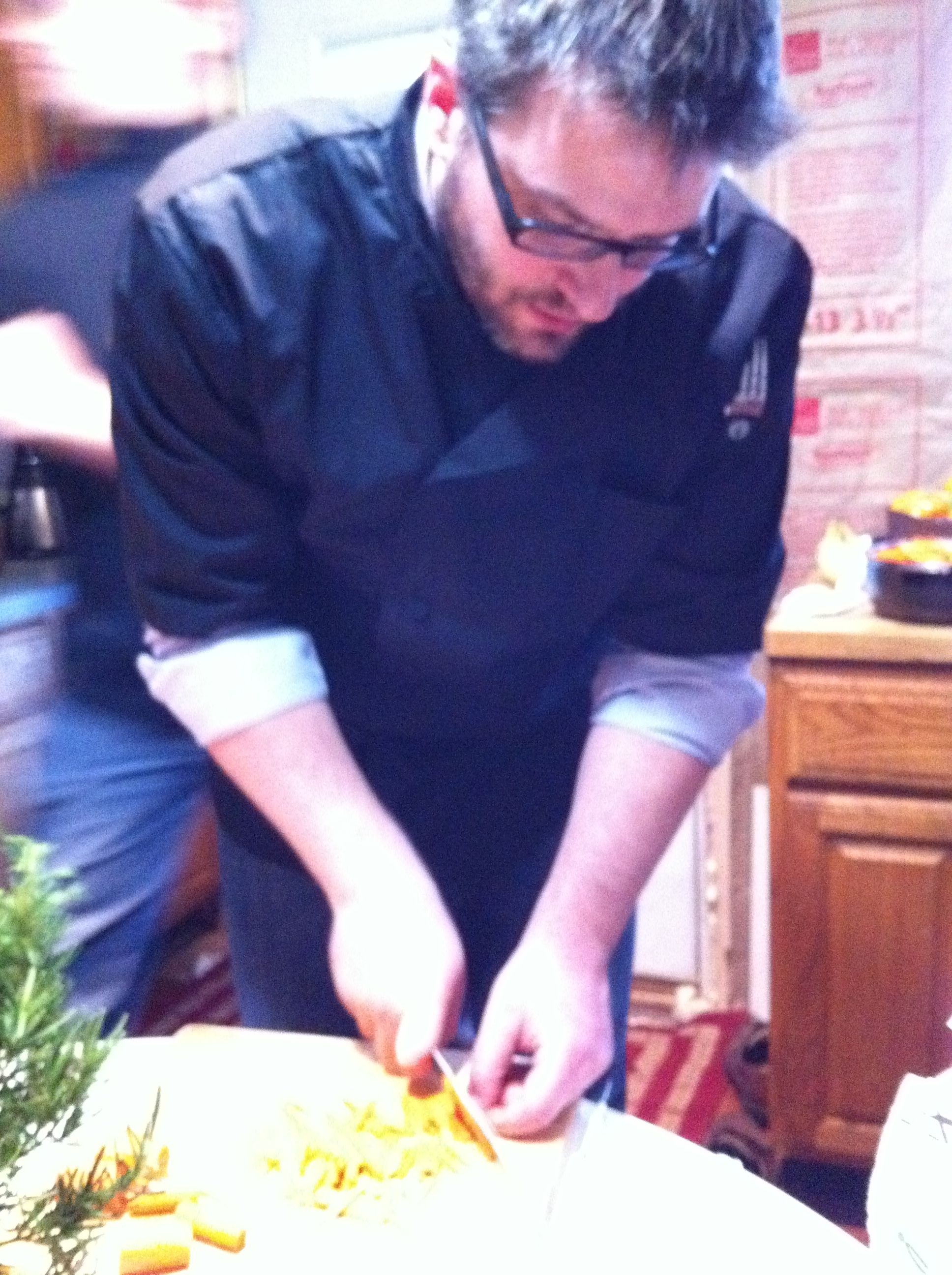
My husband Jason is a true amateur chef—at least if you understand amateur as a French word derived from amare: to love. He cooks because he loves to, and he cooks for the purpose of showing love to others.

* * * * *

One of my first significant encounters with Jason’s cooking took place at a birthday dinner he prepared for a friend—a friend who happened to be (and still is) his ex-wife’s partner.

At the time, the birthday dinner plans didn’t strike me as unusual. Jason and I had been dating for about a month, and I knew he was close to his ex and her partner. I had also heard (but hadn’t yet fully experienced) that Jason was a great cook. Why wouldn’t he offer to make the celebration dinner?

That evening, we all chatted as friends arrived, pouring glasses of wine, helping to set the table, and keeping an eye on one-another’s children as amazing scents wafted from the kitchen where Jason was working his magic.

It wasn’t until we sat down around the table to give thanks for the food and for our friend on her birthday that the beautiful peculiarity of the event struck me—with enough weight to trigger a physiological response: goose bumps on my arms and a tingle of emotion rising up behind my eyes.

My boyfriend just prepared a dinner to celebrate his ex-wife’s partner, I thought, with amazement.

The sentence rolled through my mind like a ticker tape all evening, taking on slightly new meanings and more weight each time. My own life had gone through its share of rough waters the past few years, deadening what had once been an optimistic expectation that there was goodness in the world. That birthday dinner made me believe in the possibility of redemption. It suddenly felt like anything that seemed impossible to the world was, in fact, possible. Especially around a table.

 * * * * *

chefjacketAs our relationship developed over the months, Jason continued to surprise me with his capacity for rendering not just delicious flavors, but also soul-feeding grace. I soon realized that for him, the food and the emotional substance go hand in hand.

My first Christmas with Jason’s family (just days after we got engaged) was my introduction to his extended family and their collective love for food. Jason’s aunt is African American, and in her kitchen, Jason and his cousins combined all they had learned from Aunt Gina and all they had taught themselves, creating a truly fusion Christmas dinner. The traditions of the older generations blended with the new, as recipes from the African-American South were served up next to recreated dishes that had recently been tasted in Chicago’s hippest restaurants.

In our own home after we married, “What’s for dinner?” became our young daughters’ most eagerly-posed question. Their very favorite answer was one that rose unmistakably from the kitchen to their noses—roasted cumin, peppercorns, coriander, cardamom, and cinnamon being ground together for Jason’s Tikka Masala. I loved watching our daughters’ tastes and appreciation for delicious and new foods develop. I also loved the subtle yet powerful ways our two families first got to know one another and then blended and bonded over conversations around the table. Dinners that take time and care to create, it seems, demand meal times that mirror that time and care.

Jason’s cooking skills also make our home a favorite destination for friends—those who love to eat as well as those who love to cook. As our circle of food-loving friends began to grow, Jason and I decided to host an annual chili and cornbread cook-off. The event has evolved and grown over the years (eight and counting!), but the heart of the event has stayed the same: It’s an opportunity for us to bring together friends from all parts of our lives—friends we know from church and friends from the local music scene, foodie friends and work friends, family from Chicago and friends we know through our daughters’ schools. The event lets us gather the often-disparate parts of our lives—each with their own cooking styles and secret family recipes—and create a single whole, a representation of who we are and who we love.

* * * * *

I won’t lie—when it comes to Jason’s cooking, the food alone is an amazing thing. But it’s the spaces those meals create that I love most.

Those of us who grew up in the church tend to see The Table as a powerful metaphor, but that doesn’t mean we can always see or articulate how that metaphor plays out in our Monday-through-Saturday lives. I saw it clearly for the first time at that birthday dinner Jason cooked so many years ago. And once I recognized it for what it is, I started to see it everywhere: in the words our now-teenage daughters share with us over dinner, in the collaborative bustle in Aunt Gina’s kitchen, in the beauty of diverse friends gathered together for a co-created meal in our home. It begins to seem that some level of powerful grace and forgiveness—of authenticity and wholeness—is always possible when people sit down together for a meal.

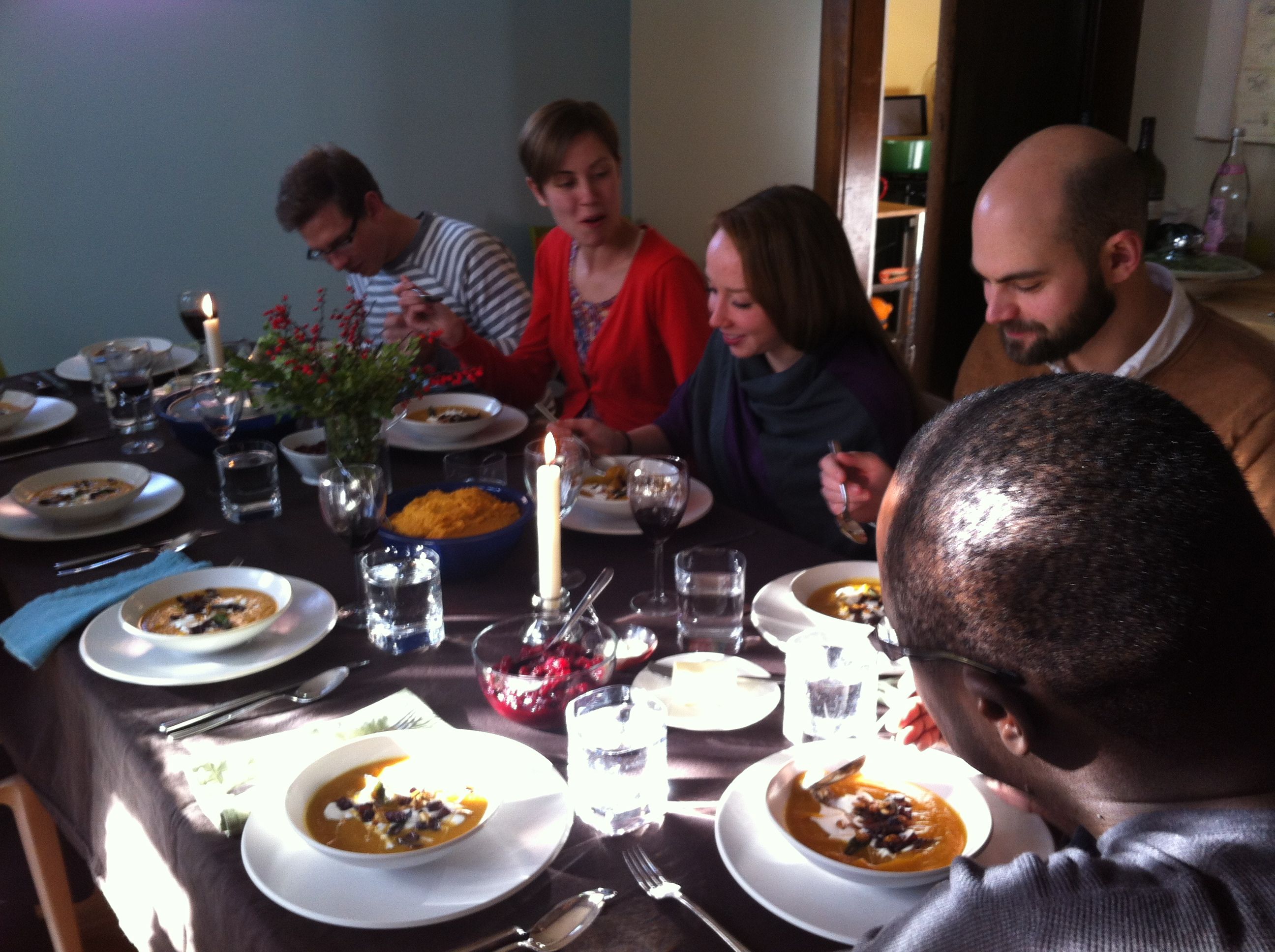
t-givingtable

A Grocer’s Daughter

I grew up in a grocery story. This is a family story that began before I was born. My father began working in the early fifties as a bag boy (also known then as a sacker)  for a small grocery chain near Nashville, Tennessee. He and my mother met in the store, and a romance that began with a smile ended up at the end of an aisle—a church aisle.

By the time Dad’s little pumpkin, as he liked to call me, entered the world, he was moving up the hierarchy of management. When I was eight years old, a new store in the chain opened, and Dad was appointed the manager. I knew my Daddy was THE BOSS, and visions of free Hershey Bars danced in my head.

When I accompanied my mother to do the grocery shopping, my dad would often walk with me to the cold drink machine (pronounced cold “drank” by some Southerners). The machine was located next to the shelves lined with Cheetos–the puffy kind that painted my fingers orange—and other salty snacks: Mr. Peanut peanuts, crispy pork rinds, corn chips, and skinny, fat-enriched potato sticks in a can. My cold “drank” of choice was Nehi Orange in a glass bottle, purchased for a dime. I’d stick the coin in a slot, open the machine door, grab the neck of the bottle, give it a tug, and out it came, cold and sweaty in my hand.

On the weekends, the “sample lady,” Mrs. Wise, served small cups of the store brand coffee, “Fit For A King,” and petite biscuits filled with Tennessee country sausage. The fragrance of breakfast greeted the customers as soon as they crossed the threshold of the store. Mrs. Wise was gracious to me and turned her head, pretending not to notice the multiple times I swiped biscuits from her serving tray.

In that store, I received a cornucopia of knowledge about fruit and vegetables from my dad. Tap a watermelon. If it sounds hollow, it is ripe and ready to cut, eat, and let the juice run down your chin. A ripe cantaloupe smells sweet. Pull back the husk of an ear of corn and look for plump rows of kernels unblemished by rotten or wormy areas.

Dad bought “local” from area farmers before “local” was part of the American food conversation. Clear glass jars of dark amber sorghum molasses made by a nearby Mennonite community enticed customers with the promise of a sweet, thick, syrupy spread for a hot buttered biscuit. Freshly dug sweet potatoes were piled high in bins, ready to accompany a customer home for baking or to use in a Thanksgiving casserole with sticky marshmallows on top.

My dad is eighty-four now, and he does the grocery shopping for himself and my mom. When I visit them, I enjoy accompanying him to a large, sprawling market unlike the grocery store where I grew up. As he gets in the car, he pats his shirt pocket to check if his coupons have stayed put. His eyes light up as he tells me the latest prices for items and compares them to the prices during his days at the helm of his store.

As soon as we enter through the sliding glass doors, Dad steps nimbly and heads for the produce section, leaving me behind as I struggle to pull out a shopping buggy that is stuck to the one in front of it. I see him from afar surveying the displays and posted prices.

I catch up with him and say, “You ran off and left me.”

He walks with purpose like a physician on her hospital rounds examining patients. He thumps and listens, feels and sees as he diagnoses the health of the produce with ease and expertise.

I look at his hands, speckled with age, and I am thankful for the work of those hands and his kindnesses to customers and vendors, and to me. I remember the fizzy, orange taste of a Nehi, the clink of the glass bottle against my teeth, and the fragrance of sausage frying and coffee brewing.

“Come on,” Dad says. “I need to get some yogurt for your mama.”

As I turn my buggy around, I tap the corner of a display of red polished apples and several roll from top to bottom. I quickly rearrange the wayward apples.

As always, I’m a grocer’s daughter.

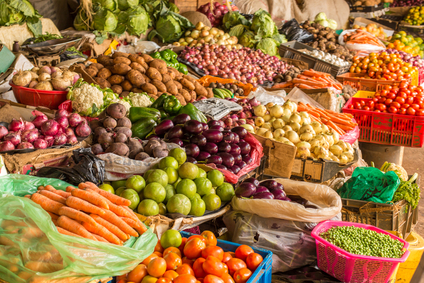
Fruit and Vegetable Market

Where I Came From: Good Question

“In our times we continually tend to assume that identity is the same as biography – that you are what has happened to you.”

                                    – John O’Donohue, “Love is the Only Antidote to Fear”

This past spring, I stepped off a train in Philadelphia, my city of origin and where I spent the first twenty-two years of my life, and where I returned in May to play best man for my baby brother’s wedding. It was by no means my first visit back to the area since I left in the mid-1990’s. There have rather been extended, sometimes lengthy return trips to Philly over the years, even a handful of botched attempts to move back “home” in the two decades since I moved away. Since becoming a parent ten years ago, we’ve managed to make it back East for the holidays with some regularity, too.

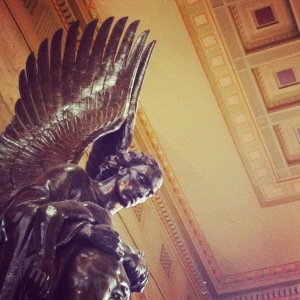
This time, however, when I emerged from the underground cavern where the train dropped its passengers, my jaw went slack. I walked wide-eyed through the historic 30th Street station, where my father spent a lot of his career working for Amtrak, and I staggered stupefied in the direction of a street I years earlier could have found blind for how often I blew into and through the city. On this day, however, I felt mystified at best, thoughts racing as I moved through the bustling, aged station, wondering, “Since when did Philadelphia become so unfathomably beautiful?”
IMG_4050

My thoughts stole to the scene at the end of The Lion, the Witch, and the Wardrobe which I had days earlier finished reading to my six year-old, Matt, in Alaska. Years following the White Witch’s defeat and aiding to free Narnia from her spell, and after assuming their rightful seats on the thrones at Cair Paravel, the four heroes go on a hunt for the enchanted White Stag. In its pursuit, Peter, Susan, Edmund, and Lucy come upon the lamppost that years earlier proved a marker in their first journeys beyond the wardrobe, a symbol bridging their lives between the war-ravaged “real” world they left behind and the magical land of Narnia they elected to explore and in which they courted adventure, and where they now presided as kings and queens.

The brothers and sisters spend a fair portion of the novel’s last pages comically puzzling over the lamppost, calling it a “pillar of iron,” “a lantern,” and “a strange device,” in such a way that reveals they have no recollection of it. Nevertheless, the appearance of it there works on Edmund “strangely,” and he says its presence runs in his mind “as it were a dream, or in the dream of a dream.”

As a child, this scene puzzled and mildly bugged me, and even after reading it to my two sons years apart it still annoyed me. Was Lewis trying to convince us that none of these four kids – not even Susan, the pragmatist – could remember their roots, where they came from, what other reality rested directly beyond the lamppost, through the cracked doors on the other side of the wardrobe? While I possess enough of a wild imagination to accept that there are magical worlds open for exploration, why did leaping into one grant you dementia or senility?

But as I wandered through and then out of the station, and soon made my way through the streets of a city I only ever dreamed of evacuating during the years that I grew up there, I swiftly understood the dim recollections of Lewis’s foursome in a new light.

30th St Outside

For all the years I’ve lived away from Philly, my line in the script of how you and I come to know each other required that I at some point in the dialogue gloomily share that I’m from a working class neighborhood located a stone’s throw outside Philadelphia.

I could name the town, but I don’t have to. It’s that Every-/Anytown, the Xeroxed one you see in every movie or show depicting life in a lower-middle class suburb or neighborhood in America.

We had the requisite K-Mart, the Blockbusters, 7-11s, Dunkin’ Donuts, and all the fast food chains. Some of these businesses have swapped signage over the years, have magically turned into Targets or Olive Gardens, but this doesn’t suggest anything’s changed by a long shot.

Never mind that while I grew up there, I looked a lot like Napoleon Dynamite – but only if Napoleon Dynamite also battled severe acne. I also wore a headgear during the stage of development at which we’re most vulnerable and going all hormonally wonky inside. Although I dated (primarily, youth group) girls, the cool kids, the jocks at the small Christian school I attended felt overly inclined to call my friends and I “faggots” with an alarming and grave degree of frequency and ridicule. That school housed itself in what today still looks like an oversized version of your dad’s backyard aluminum storage shed.

Perhaps it was the rhythm of that backdrop, coupled with my unfortunate position in the social hierarchies we’re either gracefully or brutally assigned that punctuated or clarified my attachment to select songs dominating the airwaves on rock radio in Philadelphia then; songs like “Where the Streets Have No Name” (U2), “Born to Run” (the Boss), “Round Here” (Counting Crows), and one extended song I’ll only call “Anything by REM before Monster.” These songs and others became fuel for my future launch out of town, the soundtrack for the car in which I would speed towards the westward-setting sun when I rolled the credits on the pitiful melodrama of my first two decades.

The Philadelphia of  my youth seemed defined by a polarizing awareness of an inconsolable isolation in the midst of what others around me so blithely embraced as familiar and true, or charismatically accepted as their birthright and rightful inheritance.

So, in all the years since I hit the road, Kerouac and Springsteen style, I’ve boldly and assuredly assumed I knew where I was from. I had my script so fine-tuned only Brando could improve on it.

But in a way similar to Peter, Susan, Edmund, and Lucy’s amnesiac regard of the lamppost in the woods of Narnia, I emerged from a train this summer and discovered I’d landed in an absolutely unfamiliar, barely recognizable, and – though roughly hewn – a beautifully and enviably designed city that happens to go by the name of Philadelphia.
Downtown Philadelphia

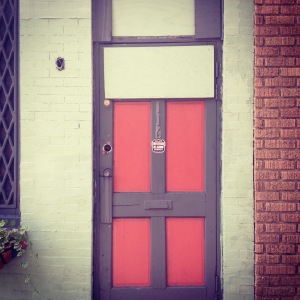
That day, as I wandered the streets of a city I thought I knew – and for the duration of my three-week trip back “home” – never mind the claw marks with which I still frame the word – I discovered that I’d misplaced my script. Shortly after landing in the place I’m apparently from, I’d thoroughly and absolutely forgotten the lines I’d for so many years labored over and consigned to the expertly wrought grooves of habit and memory.

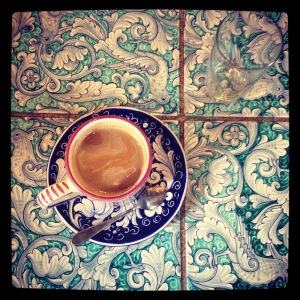
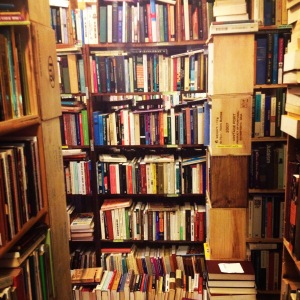
In other words, something I once assumed I knew inside out appeared in an unrecognizable moment as if “it were a dream, or in the dream of a dream.” And, for reasons I’m still puzzling over, the lay of the land instead appeared stunning and remarkably beautiful in every direction.
La Colombe Philly   UPenn Used Bookstore

Where I Came From: Perspectives from the Kitchen Sink

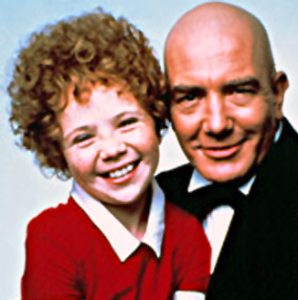
Annie, the orphan of curly red-headed fame was a staple of my childhood years. The VHS tape of her singing about “Tomorrow!” was often played in our down time as children. In it, Annie and the other kids of the city orphanage are longinAnnieWarbucksg for families and forced into fruitless hard labor by a nasty overseer, Ms Hannigan, who sloppily drinks gin in her bathtub. At the end, Daddy Warbucks steps in to love and care for Annie and all is well. (Or so I remember.)
My father was not like Daddy Warbucks. Where Mr. Warbucks was gruff, polished, and wealthy, my dad, in his most natural element, is mellow, slightly scruffy, and deeply appreciative of simplicity. At the heart of who he is, my father values hard work. Once, I heard him praise a hired kid with these words, “Someone taught you how to work, son. Thanks for your hustle today.”  Likewise, he taught me and my siblings to work. And still, in many ways, I am most at home working.

Mostly, I experienced the childhood tasks of family life with the wordless satisfaction of contributing, of doing what was expected of me. The wood pile grew as we added to it or shrunk as the pieces were carried into the house to be used in the woodstove.The flames in the rusty burn barrel or the plants that sprouted out the compost pile were things to watch and wonder about. Long sessions of grating cheese, placing it into ziploc bags to be frozen, or peeling apples, straight from the neighboring orchards, took place around the kitchen table. These were the normal activities of money-saving and country-living as far as I knew.

However, in one unfortunate incident of my childhood years, I was channeling my pre-teen Annie-angst about my “hard-knock life.” My father asked me a question, and I, filled with the injustice of having to wash the family dishes, muttered something snarky in response. I know it involved the dreadful command for him to “Shut up!”  Whatever sarcasm and disrespect I mumbled over the sink of soapy water must have caught my gentle dad at the wrong moment. His anger had a momentary flare. Amplified words about gratitude and “how good I have it” filled the kitchen space as he pulled me away from the kitchen sink. A generally good kid that wanted to please, I flushed with shame.


Years later, again up to my elbows in soapy water, a mountain of dishes awaited attention. The movement of many women in a kitchen, which could have been disastrous, resembled well-moving traffic patterns. All around me, to and fro, women dealt with leftovers, scrapped excess into the trash, dried the now-hot items and put them back into their cabinet home.

I was now a live-in staff member for a home that welcomed women in crisis–community meals and hence, community dish-washing were a regular part of our life together.  Many of these women had indeed had a “hard-knock life”–victims of others’ choices as well as their own; lives of poverty, trauma, and tremendous hardship. The women shared the common ground of being pregnant or having newborns. Their bellies, in various stages of soft roundness, gave witness to their motherhood. Their scars, tattoos, and biting humor gave witness to their past.

For the most part, dish-washing is the forgettable in-between activity of the more significant moments of meals and time spent together.  But for my eyes, this task was a place of great beauty, the dance of a community that knew how to work together.

For me, it was a feeling of home, similar to that of my childhood years.  But now, instead of moving under the protective gaze of my father, I was in the role of parent, teaching others to contribute to the wellbeing of our household, engaging everyone in money-saving tasks, and holding people accountable to inappropriate remarks.

With my mother at his side, my father had built my childhood home from his know-how, hard work, and long-suffering patience, slowly calling it into creation.  I had built the home for women out of the bones of an old, abandoned property, straight from the sheer goodness of God and from hours and hours of gut-wrenching, sacrificial work. In physically building a place, it has a special hold on you.  It helps me understand my father better.

Many of the women who I shared that kitchen with don’t have a father in their lives. Some never knew their father; others associate their father with the drugs and violence that he brought home. Many of those women grieve the fact that they will raise their children without a father. After years of hearing the stories of these women, it is painfully obvious that my father’s kitchen message was right. I have every reason to be grateful.

How good I had it.  

IMG_2866


Where I Came From: Stories from the Hunt

We shall not cease from exploration
And the end of all our exploring
Will be to arrive where we started
And know the place for the first time.

~ T.S. Eliot, “Little Gidding” from Four Quartets

Ever since the 1960s, the Turner family has gone on a goose hunt the weekend before Thanksgiving in Eagle Lake, Texas, the self-proclaimed goose hunting capital of the world.  These hunts are visceral experiences with blood, guns, and excruciatingly miserable conditions involving 4 AM wakeups, late November temperatures, wet rice fields, and four hours of sitting in those wet rice fields. They are an acquired taste even for most avid hunters.

“Stories from the hunt” are an annual ritual performed generally the night before or the night after the hunt, and are lathered heavily in heart attack barbeque, beer, and gin and tonics. My grandfather, Jack Rice Turner, began taking my father when he was still an adolescent, and the stories of his first hunts still get retold year after year. They are told differently, but always with a twinkle in the eye of my grandfather who is the patriarch of the group we go hunting with and leads the way in all things Texan (i.e. drinking, shooting stuff, story telling, and general swashbuckling confidence (despite the fact that he is now barely over 5 feet tall as he has shrunk in his late 80s)). These stories always lead to my grandfather recalling more stories, from his 40 years in the Navy and Navy Reserve, 60 years of marriage to my grandmother who is one of the first women mayors in south Texas, and 50 years of being an architect along the Rio Grande River Valley. Amidst these stories, there will certainly be the hundredth retelling of the improbable three turkey kill with one rifle bullet (which I actually witnessed when my grandfather shot and killed two turkeys with a rifle bullet, then had a third die by what I can only postulate was a heart attack), the retelling of the turkey stolen by a bobcat story, and the always memorable telling of the other immaculate shot my grandfather managed: the double Canadian Goose in flight shot, where with a single shot he managed to kill two 25 pound geese while they were flying.

These grandiose stories about my grandfather will be offset by some serious ribbing and stories full of hilarity. The story of my first hunt will be retold where I was enlisted as a retriever and had to chase down and corral geese almost the same height as my 7 year old soul; one goose actually ended up chasing me instead of me chasing it. Or the more recent, fresh story will be retold about my grandfather accidently shooting a very slow and low flying crane despite everyone yelling at him not to shoot it and then had to hide it when the game wardens came over to our hunt.

All of these stories form the fabric of several generations of family hunts, but oddly, for many of these story telling events and even for some of the hunts themselves, I was not there. When I was younger, my introversion and love of books led me to spend large chunks of the these hunts reading books. In sixth grade, I spent most of the hunt reading The Lord of the Rings, in seventh, C.S. Lewis’ space triology, in 8th, the Count of Monte Cristo. I would barely leave my room while I was reading. I preferred the companionship of my books over my family, and in an all-too-familiar refrain in my life, I escaped into myself. When I got older and found myself adrift, in and out of college and in and out of seasons of depression, there were several years where I didn’t even go to the hunt with my family. I was so reclusive and lost in my own world I could not find it in myself to go to the one thing my grandfather and my father loved the most. They loved having their sons, their friends, and their stories, but I did not love myself, nor know myself, nor want to find myself in my grandfather and his stories.

In the past five years, we have been back to Eagle Lake several times. I have been back three times. We have welcomed a brother-in-law, we have shared stories, and I have watched my grandfather. We have witnessed the sunrise amidst the torrent of a thousand rising geese burning up the sky with their black, brown, and white flying V’s as their honking calls roar down on us like the thunder and wind of a sweeping Texas storm. And as I write, these are the sights I see more vividly than anything else my childhood holds, and I feel the rise and catch in my throat like I once felt when I first read about the Riders of Rohan charging down into Helms Deep in The Lord of the Rings, and I see the twinkling eyes of my grandfather, and I remember this is who I am from, this is from where I came.

Where I Came From: Lost in a Small Town

I can drive, with moderate success, in most major American cities.

The D.C. beltway? No problem. I even go the right direction, most of the time. Los Angeles to Ventura on the 101? Done it with (extra points!) a puking child in the backseat. Chicago? Boston? Philadelphia? Check, check, check, though I always wonder why the Philly drivers are so mean.

However.

There is one city, one very small city, in which I consistently drive the wrong way down one-way streets, miss stop signs, and drive slower than the speed limit, trying to find my way. And that would be:

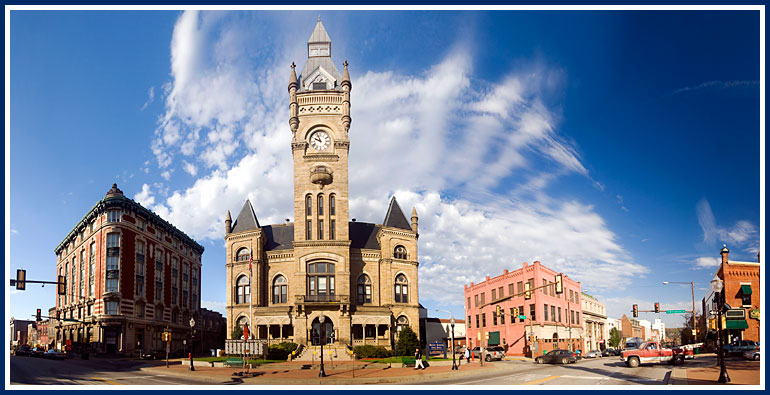
Butler, Pennsylvania. Population 13.757.butler

My hometown.

I noticed this strange phenomenon a few years ago. One day, after driving the wrong way on a street near my former elementary school, I pulled over, berating myself and thanking God that no one had been coming the other way. How could I be so lost in a place that was so familiar? And that’s when I realized my problem.

I knew how to walk these streets, not drive them.

You see, I was one of those people who wanted one thing from adulthood: to get out of my hometown . It was too small. Too ingrown. Too boring. And so, as soon as I could, I left. In my small gold Nissan I began racking up the miles. College was a three hour drive. North Carolina, where I worked one summer, was nine hours.  I did not drive to Northern England, but I lived there for a year, wearing out my EuroRail pass along with my big green backpack.

After college I surprised myself by returning to Western Pennsylvania, but it was Pittsburgh, not Butler, where I found my first job and my first post-college apartment. Pittsburgh is only an hour drive from Butler, but it seems much further. There are ethnic restaurants other than the americanized chinese buffet, people who aren’t white, and community events that don’t involve gun raffles or high school sports teams.

I’ve been in Pittsburgh for fifteen years now, and it can be easy to roll my eyes at my hometown.

But that wouldn’t be fair.

That day in the car, when I realized that I knew how to walk but not drive in my hometown, I also realized that I have never lived as a grown-up in Butler, Pennsylvania. Could it be that my experience there seems limited because I was, um, ten? Could it be that I still feel ambivalent and awkward because my culminating experience was in high school? These were not my easiest years.

And what is beginning to open up in me is not a desire to return to my hometown (no, I like my Indian food too much), but a sense of grace and openness to a place that was once too familiar. I can take my kids to the Butler Farm Show. I can enjoy local marching bands at the Christmas parade, send my husband to hunting camp, and read the local newspaper without mocking it (much).

Because when it comes down to it, I just don’t have as much to prove as when I was fifteen.

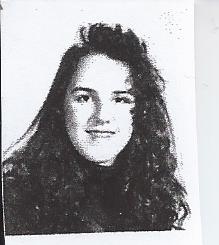
high school photo

And I don’t use nearly as much hairspray either.